
Rapid electronic prototyping is less about having access to a prototyping service and more about how fast a single design-build-test loop actually closes – because for a hardware startup, every week a cycle takes is a week of runway spent without a validated answer. This guide is for founders and engineering leads who already understand prototyping in principle and want to know specifically what compresses time-to-working-board, what silently extends it, and how to structure a build so iteration speed becomes a deliberate decision rather than an accident of scheduling.
TL;DR
- Cycle time, not iteration count, is the variable that determines how much runway a hardware build consumes – two fast cycles can cost less time than one slow one.
- Most delay in a prototyping cycle comes from sequencing, not fabrication: waiting to start sourcing until layout is final, waiting to write firmware until boards arrive, and waiting on a single reviewer before ordering.
- Quick-turn PCB fabrication only compresses the smallest part of the timeline. Parallelising component sourcing, firmware bring-up preparation and design review is where the real time is won or lost.
- A slow cycle has a direct cost in burn: a six-week loop that should take three weeks is not “a bit behind schedule” – it is a measurable fraction of a seed round spent waiting.
- Compressing cycle time has limits. Skipping DFM checks or component availability review to save days at the front of a cycle routinely adds weeks at the back of it.
- Zeus Design runs its rapid prototyping engagements as a parallel-track process – sourcing, layout review and firmware preparation running concurrently rather than as a single serial queue.
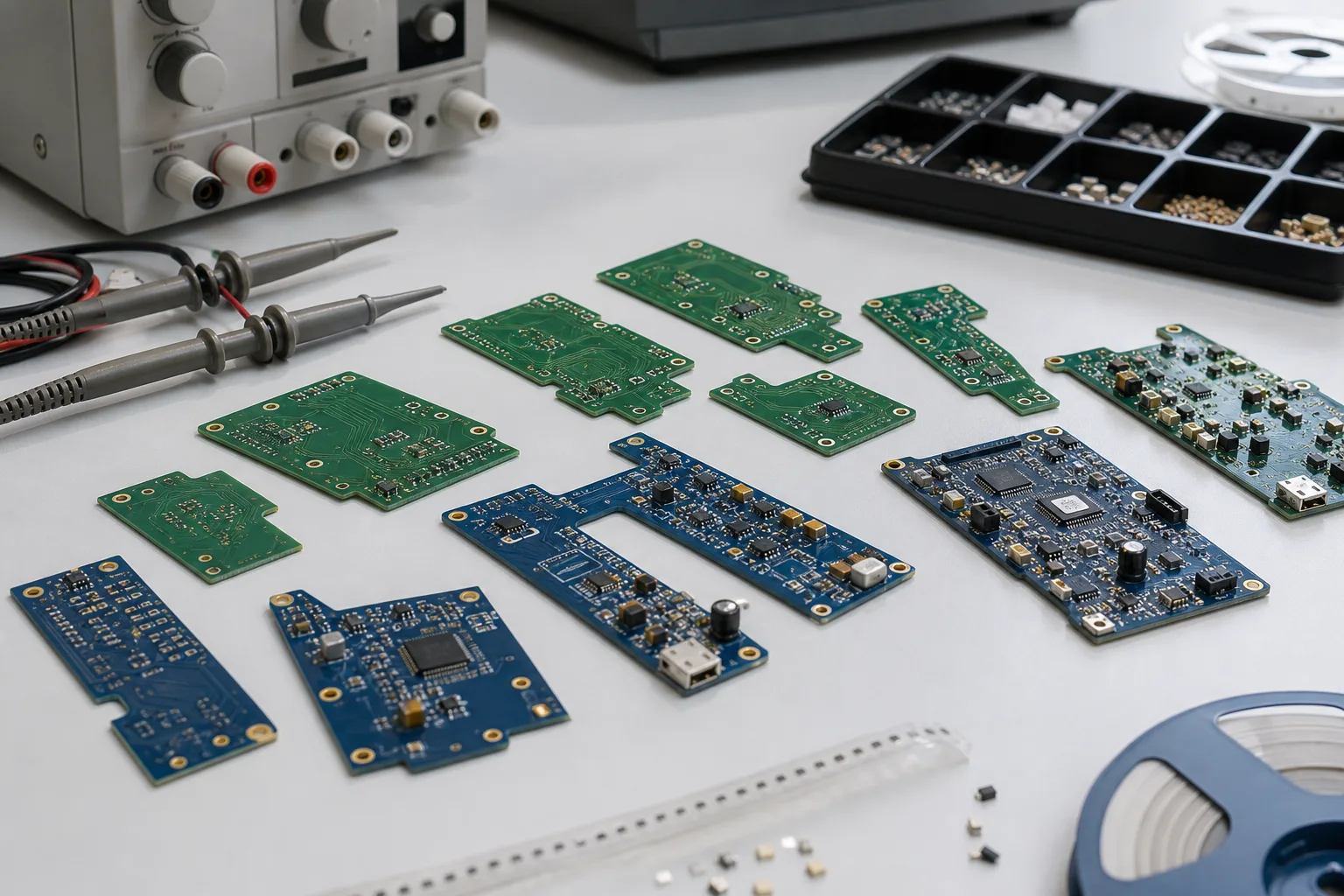
Why Cycle Time Is the Number That Matters
Most hardware teams measure prototyping progress in revisions: Rev A, Rev B, Rev C. That is a useful way to track scope, but it hides the variable that actually determines whether a startup reaches its next milestone on budget – how long each revision takes from “we know what to change” to “we have a tested board that proves whether the change worked.”
Two teams can each need three prototype revisions to reach a production-ready design. If one team closes each cycle in three weeks and the other in seven, the difference is roughly three months of runway – calendar time spent paying salaries, rent and supplier invoices while waiting for the same number of answers. CB Insights research into startup failure consistently lists running out of cash before reaching the next milestone as one of the most common causes of shutdown, which is precisely the failure mode a slow prototyping cycle accelerates.
This is the core argument for treating rapid electronic prototyping as a cycle-time problem rather than a procurement decision. The question is not “can we get a prototyping service” – most hardware teams can. The question is whether the cycle is structured to produce an answer in the minimum calendar time the engineering actually requires, or whether it is quietly padded with avoidable serial delay.
What Actually Makes a Cycle Fast or Slow
Fabrication speed gets most of the attention because it is the most visible and most marketed part of the process. It is rarely the dominant factor in total cycle time.
Serial Decisions That Do Not Need to Be Serial
The single most common cause of a slow prototyping cycle is sequencing work that could run in parallel as if it had to run one step at a time. Teams routinely wait until layout is fully finalised before starting component sourcing, wait until boards physically arrive before writing a line of bring-up firmware, and wait on one senior reviewer’s calendar before releasing files to fabrication. None of these dependencies are technically necessary for most of the cycle’s duration.
Sourcing can start against a draft bill of materials (BOM) as soon as the major components are selected, well before layout is final. Firmware bring-up code, register maps and test scripts can be written against the schematic and datasheet before a physical board exists. A design review can happen against a checklist with a defined turnaround window rather than waiting for one person’s open calendar slot. Each of these changes collapses calendar time without changing the engineering scope.
Quick-Turn Fabrication Is a Small Piece of the Timeline
Quick-turn PCB fabrication can produce bare boards in 24-72 hours for straightforward two- to four-layer designs, and services such as JLCPCB and PCBWay have made this commodity-priced and widely available. That speed is genuinely useful, but fabrication is usually the shortest segment of a prototyping cycle, not the longest. A team that fixates on fabrication turnaround while leaving sourcing, review and firmware preparation in series has optimised the smallest lever and left the largest ones untouched.
Decision Bottlenecks
Cycles also slow down at decision points that have no fixed deadline: waiting for a stakeholder to approve a component substitution, waiting for a go/no-go call on whether a marginal test result is acceptable, or waiting for budget sign-off on the next fabrication run. These delays do not show up on a Gantt chart as “fabrication” or “assembly” – they show up as gaps between stages, and they are frequently the largest single contributor to a slow cycle. Naming a single decision-maker with a committed turnaround time for each gate is a process fix, not an engineering one, and it is often the highest-leverage change available.
Component Availability Surprises
A design that looks complete on paper can stall for weeks if a key part – a wireless module, a specific power management IC, a connector – has a long lead time or is out of stock at the quantities needed. Checking real-time stock and lead times against distributors such as Digi-Key during component selection, not after the BOM is finalised, prevents a sourcing delay from appearing midway through a cycle that otherwise looked on track.
The Runway Cost of a Slow Cycle
It is worth making the burn-rate cost of cycle time explicit, because it rarely gets quantified in planning conversations. A hardware startup spending, for example, $40,000-$60,000 AUD per month on salaries and overheads loses roughly $10,000-$15,000 AUD in burn for every additional week a prototyping cycle runs beyond what the engineering scope requires. A cycle that should take three weeks but takes seven has not just slipped a deadline – it has consumed an additional $40,000-$60,000 AUD in runway for the same engineering outcome.
This framing matters because it changes how compression decisions get evaluated. Spending an extra $3,000-$5,000 AUD on expedited fabrication or assembly to save two weeks is not an indulgence if it preserves two weeks of runway worth more than that in burn. Conversely, sequencing work in series to “keep costs down” on paper can be the more expensive choice once the calendar cost is counted. Startup Genome’s research on premature scaling and growth pacing makes a related point: the cost of moving at the wrong speed is rarely visible until the runway and the milestone fail to line up.
Concrete Tactics to Compress Time-to-Working-Board
Compressing a prototyping cycle is a set of specific, repeatable decisions rather than a single trick. The tactics that consistently shorten real cycles:
- Source against a draft BOM, not a final one. Start checking distributor availability and lead times as soon as the major components are chosen, and revise the order as layout finalises rather than waiting for a frozen BOM.
- Write bring-up firmware before the board exists. Register maps, peripheral initialisation sequences and basic test scripts can be drafted against the schematic and datasheets, so the board is exercising real code within hours of arrival rather than days.
- Time-box design review. Replace open-ended “whenever someone is free” review with a fixed 24-48 hour review window and a named reviewer, so files are not waiting on a calendar.
- Use quick-turn fabrication deliberately, not by default. Reserve expedited fabrication for the cycles where schedule risk is highest, and use standard turnaround where slack already exists elsewhere in the plan.
- Define pass/fail criteria before the board is built. A cycle that ends in ambiguous results – “it sort of works” – forces a second cycle just to get a clear answer. Defining specific, measurable test criteria up front prevents that wasted loop.
- Run DFM checks at every revision, not just the last one. Catching a footprint or clearance issue at Rev A costs minutes. The same issue found at Rev C, after firmware and mechanical fit depend on the existing layout, costs a full extra cycle.
- Pre-clear long-lead components before they block a cycle. Identify the one or two parts most likely to have supply risk – wireless modules, specialised power ICs – and confirm stock before they become the reason a cycle stalls.
None of these tactics require exotic tooling. They require treating the cycle as a project to be actively managed rather than a sequence of vendor handoffs.
Where Compression Has Limits
Speed is not free, and the tactics above have a failure mode: cutting the engineering steps that exist specifically to prevent expensive rework. Skipping a design-for-manufacture (DFM) pass to save two days at fabrication routinely costs two to four weeks later when a respin is required because a footprint or clearance issue was not caught. Skipping component availability checks to place an order faster can produce a board that cannot be repeated at the next revision because the part is no longer in stock.
The discipline is to compress the parts of the cycle that are genuinely serial by habit, not by necessity – sourcing, firmware prep, review turnaround – while keeping the checks that exist to prevent a second, larger delay later. Sierra Circuits’ guide to PCB prototyping makes the same point from a fabrication perspective: rushing past basic design rule checks to save fabrication time is one of the most common causes of an entirely avoidable second build.
How Zeus Design Structures Rapid Electronic Prototyping
Zeus Design’s rapid prototyping service is built around running the compressible parts of a cycle in parallel rather than in series. Component sourcing begins against a draft BOM as soon as major parts are selected through circuit board design and layout, rather than waiting for a frozen design. Firmware bring-up code is prepared against the schematic before boards exist, so functional testing can begin within hours of assembly rather than days. Design review runs against a fixed checklist with a committed turnaround, removing the open-ended “waiting on a reviewer” delay that quietly extends so many cycles.
This does not mean skipping steps. DFM review happens at every revision, not just the final one, and component availability is checked before a BOM is locked – the checks that prevent a second, more expensive cycle stay in place. The compression comes from removing unnecessary serial dependency, not from removing engineering rigour.
For a broader walkthrough of what a full prototyping engagement covers stage by stage, see Zeus Design’s guide to rapid prototyping services for electronics products, and for how iteration cycles fit into the wider schematic-to-board process, see electronic prototyping services: concept to working board.
How This Connects to Related Services
Cycle-time compression only works if the disciplines around prototyping are integrated rather than handed between disconnected vendors. Electronics design decisions made early – component selection, architecture, interface choices – determine how much sourcing risk and layout complexity the prototyping cycle inherits. A clean upstream design produces fewer review cycles and less component substitution downstream.
Embedded firmware prepared in parallel with hardware, rather than after boards arrive, is one of the single biggest cycle-time levers available, because firmware bring-up is frequently the longest-lead activity in a prototype cycle once the board itself exists. Teams that treat firmware as a separate phase that starts after assembly are choosing a slower cycle by default, whether or not that is the intention.
FAQs
What is rapid electronic prototyping, specifically?
Rapid electronic prototyping is the practice of compressing the time between a design decision and a tested, working board that proves whether the decision was right. It is not just fast PCB fabrication – quick-turn boards only address the smallest part of a typical cycle. The larger gains come from parallelising component sourcing, firmware preparation and design review rather than running them in series.
How much faster can a prototyping cycle realistically get?
Teams that move from fully serial workflows – source after layout, write firmware after assembly, review whenever a senior engineer is free – to a parallel-track process commonly cut total cycle time by 30-50%, without changing the engineering scope. The exact figure depends on how much of the existing delay is sequencing-driven versus genuinely fabrication or assembly-limited.
Does rapid prototyping mean skipping DFM or quality checks to save time?
No – that trade tends to cost more time than it saves. Skipping a design-for-manufacture review to save a few days at fabrication routinely produces a respin that costs two to four weeks once the issue surfaces downstream. Genuine cycle compression comes from removing unnecessary serial delay, not from removing the checks that prevent a second, larger delay later.
What is the biggest single cause of a slow prototyping cycle?
Decision bottlenecks and unnecessary sequencing, not fabrication speed. Waiting for a single reviewer’s calendar, waiting until layout is final to start sourcing, and waiting until boards arrive to start firmware all add calendar time without adding engineering value. Naming a committed reviewer and a fixed turnaround window for each gate is usually the highest-leverage fix available.
How does cycle time actually affect a startup’s runway?
Every week a prototyping cycle runs longer than the engineering scope requires is a week of salaries, rent and overheads spent without a validated answer. For a team burning $40,000-$60,000 AUD a month, an unnecessary four extra weeks on a single cycle can represent $40,000-$60,000 AUD of runway spent on calendar time rather than engineering progress – money that often matters more than the prototype build cost itself.
Can firmware development really start before hardware exists?
Yes, for most of the bring-up code. Register maps, peripheral initialisation sequences and basic test scripts can be written directly against the schematic and component datasheets before a physical board is assembled. This means functional testing can begin within hours of the board arriving rather than days, which is one of the most reliable ways to shorten a rapid electronic prototyping cycle without cutting engineering scope.
When does it make sense to pay for expedited fabrication?
When the time saved is worth more than the premium charged – which, once burn rate is counted, is more often than founders assume. If expedited fabrication costs an extra $3,000-$5,000 AUD but saves two weeks of runway on a team burning $10,000-$15,000 AUD a week, the premium is the cheaper option. Reserve it for the cycles where schedule risk is genuinely highest rather than applying it by default to every build.
Conclusion
Speeding up a hardware build is ultimately a scheduling discipline as much as an engineering one. The teams that move fastest are not always the ones with access to the quickest fabrication house – they are the ones that have removed unnecessary serial dependency from sourcing, firmware preparation and design review, while keeping the checks that prevent a second, more expensive cycle later.
For hardware startups where every week of cycle time has a real cost in runway, the right question is not whether a prototyping partner can build a board quickly, but whether the overall cycle is structured to produce a validated answer in the minimum calendar time the engineering genuinely requires.




0 Comments