Rapid prototyping services for electronics products move founders, hardware startups and product teams from concept to a working, testable circuit board – without committing to full production tooling. This guide is for product owners and engineers evaluating prototyping partners, and covers what a professional service delivers across proof-of-concept builds, functional PCB prototypes and design-for-manufacture (DFM) iterations.
TL;DR
- Rapid prototyping compresses early hardware development by producing testable boards in days or weeks rather than months.
- A professional service covers proof-of-concept (PoC) builds, functional PCB prototypes and DFM iterations – not just board fabrication.
- The biggest value is early risk reduction: catching design problems before tooling, compliance or volume manufacturing costs are locked in.
- Quick-turn PCB fabrication alone is not a prototyping service – circuit design, schematic capture and component sourcing are also part of the picture.
- Zeus Design offers rapid prototyping for electronics products in Australia, including PoC builds, PCB layout, embedded firmware and DFM reviews.
Why Rapid Prototyping Matters in Electronics Development
Hardware development is expensive to get wrong. Once a product moves into tooling, compliance testing or volume manufacturing, the cost of discovering a fundamental design problem multiplies quickly. A circuit that draws twice the expected current, a wireless module that fails regulatory pre-compliance, or a footprint error that causes every board to be reworked – these are the kinds of problems that rapid prototyping is designed to surface early, while changes are still cheap.
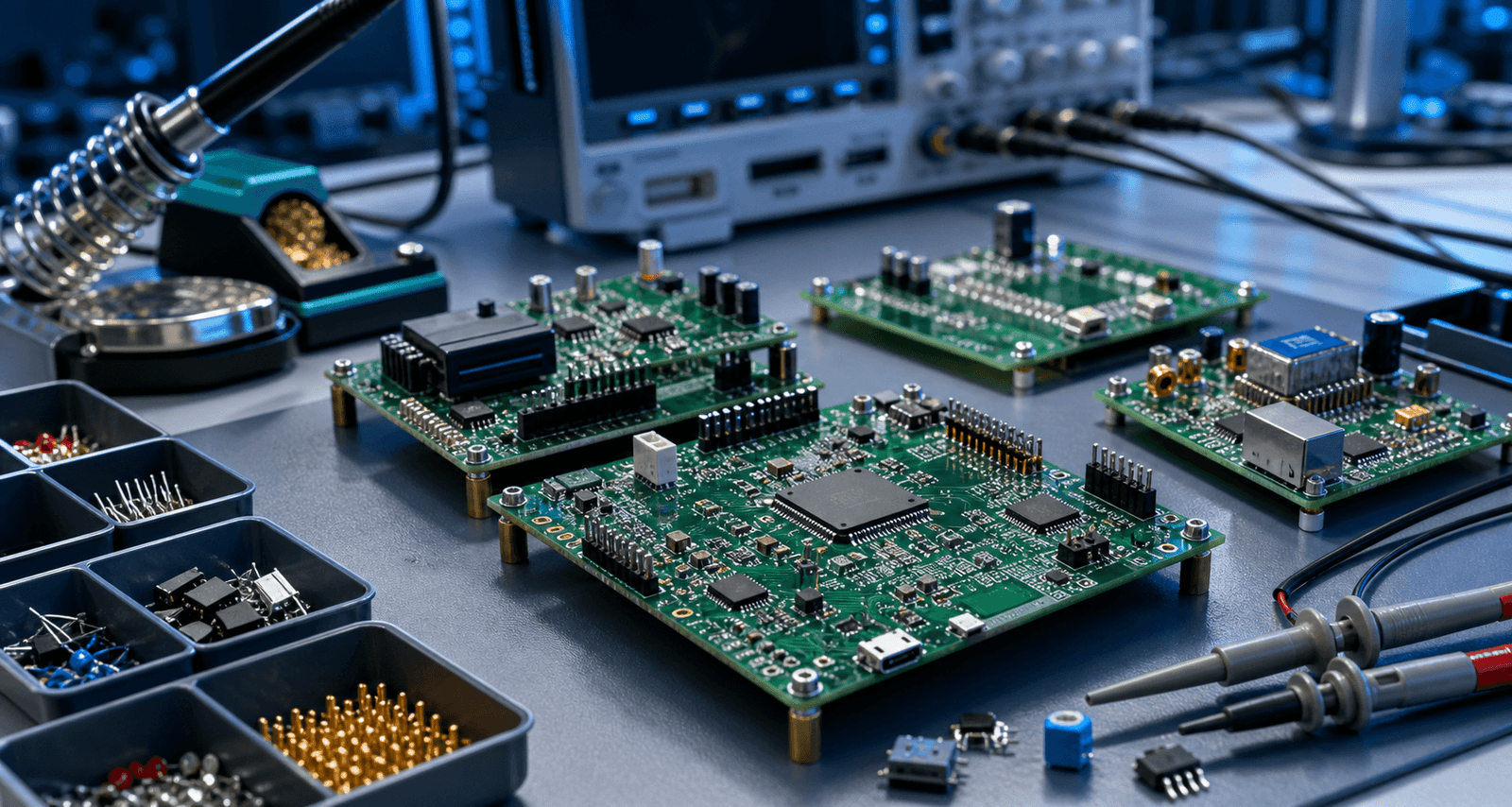
The term “rapid prototyping” gets used loosely in electronics. Sometimes it refers to quick-turn PCB fabrication services that produce bare boards in 24-72 hours. More accurately, a complete rapid prototyping service also covers the engineering work before the boards are ordered: circuit design, schematic capture, component selection, PCB layout, and the assembly and functional testing that follows. The speed comes from combining design experience with established supplier relationships and a focused, iterative workflow.
For hardware startups working under investor timelines or competitive pressure, the difference is concrete. Getting from concept to a functional, testable board in two to four weeks – rather than three to six months – means more iteration cycles before launch, earlier investor demos, and better-informed production scoping.
What Rapid Prototyping Services Include
A full rapid prototyping engagement spans several stages, each building on the last.
Proof-of-Concept Builds
A proof-of-concept (PoC) build tests the core technical hypothesis of a product – usually whether a key circuit, sensor, wireless link or power architecture works well enough to warrant a full design. PoC boards are intentionally minimal. They are not production-representative, but they answer the questions that matter most at the feasibility stage.
Common PoC activities include breadboard or prototype board assembly, basic firmware to exercise core functionality, and measurement or logging to validate performance against requirements. The output is not a shippable product – it is evidence (or useful failure data) before committing more significant engineering investment.
According to Altium’s PCB prototyping documentation, proof-of-concept iterations are a standard part of the hardware development lifecycle, with design decisions at this stage having an outsized effect on downstream cost and schedule.
Functional PCB Prototypes
Once the core concept is validated, the next stage is a functional prototype – a PCB that closely represents the final product architecture. This is where schematic capture, PCB layout, and component selection move from rough to formal. The board is assembled, tested against a requirements specification, and used for firmware development, mechanical fit checks and initial performance validation.
Quick-turn PCB fabrication services – used at this stage to compress calendar time – can produce manufactured boards in as little as 24 hours for simple two-layer designs, with four to six-layer boards typically taking two to five days depending on specification and supplier. PCB fabricators such as PCBWay and JLCPCB are commonly used for prototype-volume builds where cost and speed are the primary constraints.
At this stage the prototype should be solid enough to support parallel embedded firmware development – typically the longest-lead activity in a hardware programme.
DFM Iterations
Design for manufacture (DFM) review is the process of examining a PCB design against the constraints of the production assembly process – pick-and-place machine tolerances, soldering process requirements, panelisation, test access, and component placement rules. DFM issues found at prototype stage cost a fraction of what they cost when caught during production build.
A typical DFM iteration involves reviewing Gerber files and a bill of materials (BOM) against manufacturer capabilities, identifying tombstoning risks, thermal relief requirements, via-in-pad conflicts and component spacing violations, and updating the layout before the next fabrication run.
The IPC-2221 standard for generic PCB design, published by the IPC, provides the baseline design rules that DFM reviews reference when assessing a board’s production readiness.
When a Project Needs Rapid Prototyping Services
Not every electronics project starts from scratch – but most new hardware products need dedicated prototyping before committing to production. Signs that a rapid prototyping engagement is the right call:
- The product concept has not been built before and key technical assumptions need validation.
- The team has software or product experience but limited electronics engineering depth.
- There is a specific milestone – investor demo, pilot cohort, beta programme – that requires a working board by a fixed date.
- The product involves a new combination of technologies: a novel sensor, a new wireless module, a power management architecture that has not been characterised before.
- A previous version of the product exists, but the architecture is being redesigned for a new form factor, cost target or performance spec.
Projects that do not need a full rapid prototyping service are typically those where the design is well-understood, a previous generation board exists as a template, and the change is an incremental revision rather than a new architecture.
Technical and Commercial Risks to Manage
Rapid prototyping is not risk-free. Done poorly, it produces a board that works well enough to create false confidence while hiding problems that become expensive at production scale.
Component Availability
The global electronics component supply chain has experienced significant volatility since 2020. Components specified for a prototype may have long lead times or limited availability at production volumes. A competent prototyping partner will flag availability issues during component selection and design, not after boards are ordered. Checking distributor stock across Digi-Key and similar suppliers at the BOM stage is a basic practice that prevents expensive redesigns later.
Prototype-to-Production Gap
Prototype boards built for internal validation often use components, footprints or assembly methods that are impractical at production volume. Hand-soldered QFN packages, for example, may work for a prototype but cause yield problems on a production SMT line. Closing this gap requires deliberate DFM review at the prototype stage, not just before production.
Firmware Dependency on Prototype Hardware
Firmware developed against a prototype board often depends on specific hardware behaviours – timing, pin states at startup, peripheral initialisation sequences – that shift subtly between prototype and production revisions. Clear hardware abstraction and documented prototype-to-production differences keep this manageable.
Compliance Planning
Regulatory compliance for electronics products – CE, FCC, ACMA RCM in Australia – is determined by the hardware design, not by post-design testing. A prototype built without regard for EMC design rules, isolation requirements or RF certification paths will likely need significant redesign when compliance becomes a delivery milestone. Planning for compliance at the prototype stage avoids that.
Zeus Design’s Rapid Prototyping Process
Zeus Design’s rapid prototyping service covers the full engineering scope from initial circuit design through to functional, tested boards ready for firmware development and DFM review.
The process typically follows this sequence:
- Requirements and feasibility review – defining what the prototype needs to demonstrate, identifying technical risks, and confirming the right scope for the prototype stage versus later production design.
- Schematic capture and circuit design – formal schematic development using Zeus Design’s electronics design capability, covering power architecture, processor selection, peripheral design and interface specifications.
- PCB layout – via Zeus Design’s circuit board design service, applying DFM-aware layout practices from the start, not as a retrofit at the end of the prototype phase.
- Component sourcing and BOM management – selecting components with adequate production availability and flagging potential supply chain risks early.
- Fabrication and assembly – placing orders with qualified PCB fabrication and assembly partners, managing the build through to functional boards.
- Functional testing and firmware integration – bring-up testing, debugging, and handing over a test-ready board to the embedded firmware development track.
- DFM review and iteration – documenting design decisions, flagging prototype-to-production gaps, and feeding findings back into the next design revision.
This end-to-end scope means rapid prototyping at Zeus Design is not a fabrication service with a quick-turn label – it is an engineering engagement that shortens the path to production, not just puts something in a founder’s hand.
How Rapid Prototyping Connects to Related Services
Rapid prototyping sits in the middle of a broader development sequence – it starts with requirements and ends with production release.
Upstream, feasibility assessment and architecture decisions inform what the prototype needs to demonstrate. Downstream, the prototype feeds directly into firmware development, compliance testing, DFM optimisation and production planning. A prototyping partner that can cover adjacent stages – embedded firmware, test jig development, DFM review – reduces the coordination overhead and the risk of information being lost at handover boundaries.
Zeus Design’s integrated service model means that the same team that designs the prototype can carry the product through to production-ready hardware, firmware, and test systems. This matters most for products with tight timelines or complex system interactions between hardware, firmware and wireless connectivity.
FAQs
What does a rapid prototyping service for electronics actually include?
A full rapid prototyping service includes circuit design, schematic capture, PCB layout, component sourcing, fabrication, assembly and functional testing – not just quick-turn board manufacturing. The engineering design work before the board is ordered is where most of the value is created. Zeus Design’s rapid prototyping service covers all of these stages as an integrated engagement.
How long does electronics rapid prototyping take?
A simple proof-of-concept build can be turned around in one to two weeks from circuit design to tested board, assuming requirements are clear and components are in stock. A functional prototype for a more complex product – multiple interfaces, wireless connectivity, custom power architecture – typically takes three to six weeks for the first revision. DFM iterations and subsequent revisions add one to two weeks per cycle depending on scope.
What is the difference between a proof-of-concept and a functional prototype?
A proof-of-concept tests the core technical hypothesis with minimal scope – it answers the question “does this approach work?” rather than “does this product work?” A functional prototype is a more complete representation of the final product architecture, used for firmware development, performance validation and early compliance assessment. Most products go through both stages, with the PoC informing the functional prototype design.
When should DFM review happen during prototyping?
DFM review should begin at the functional prototype stage, not at the production release stage. Catching footprint errors, component spacing issues and assembly process conflicts at the prototype phase costs a fraction of what they cost when found during production build. Zeus Design applies DFM-aware PCB layout practices from the first prototype revision as part of its circuit board design service.
Can rapid prototyping services help with compliance and certification planning?
Yes – and this is an important reason to engage a prototyping partner with compliance experience rather than just a fabrication service. EMC design rules, isolation requirements and RF certification paths are determined by hardware design decisions made at the prototype stage. Addressing these early avoids the expensive redesigns that follow when compliance becomes a delivery requirement and the prototype was not designed with it in mind.
What information do I need before starting a rapid prototyping engagement?
At minimum: a clear statement of what the prototype needs to demonstrate, key performance requirements (power budget, data rate, operating environment), any mandatory interfaces or wireless protocols, form factor constraints, and a target timeline. You do not need a complete specification – part of the value of a prototyping engagement is working through requirements that are not yet fully defined. The clearer the must-have requirements are, the faster the first iteration will be.
How much do rapid prototyping services cost for electronics products?
Costs vary significantly depending on board complexity, component count, layer count and the engineering scope required. A simple two-layer PoC board with off-the-shelf components and basic firmware might cost $5,000-$15,000 AUD for the engineering and build. A complex functional prototype with a custom wireless module, multi-layer PCB and integrated firmware development can run $20,000-$60,000 AUD or more. The right comparison is not prototype cost versus nothing – it is prototype cost versus the cost of discovering design problems during production or compliance testing.
Conclusion
Rapid prototyping services for electronics products are most valuable when they compress the time between concept and a testable, production-representative board – while also surfacing design risks before they become expensive to fix. The distinction between a fabrication service and a full rapid prototyping service matters: quick-turn boards are just one part of the picture. The engineering design work, DFM-aware layout, component sourcing and functional testing are where the real risk reduction happens.
For hardware startups and product teams in Australia, working with a partner who can cover prototyping as part of an integrated development capability – from circuit design through to firmware and DFM – reduces coordination risk and keeps the path to production as short as possible.




0 Comments