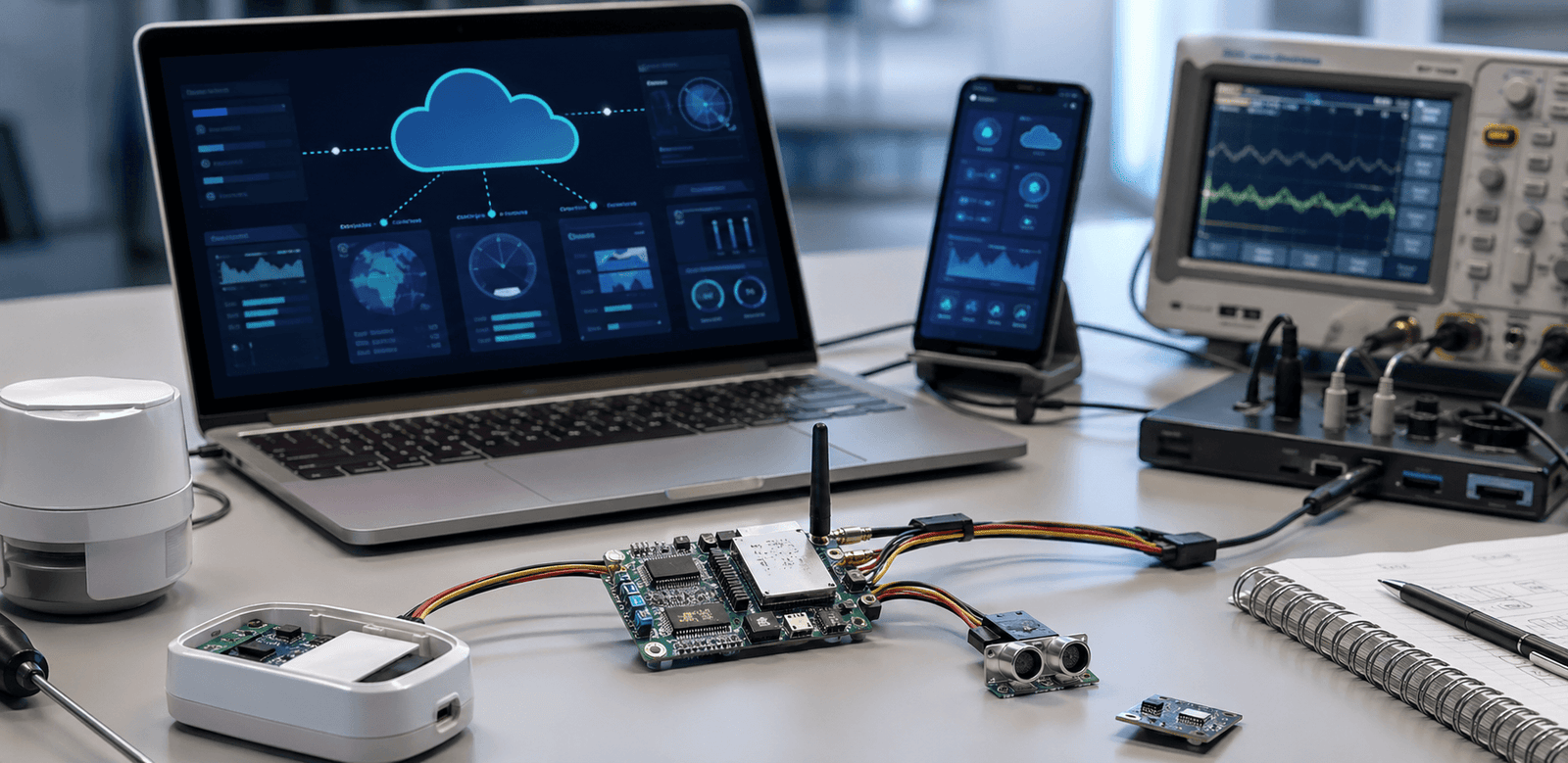
IoT development is one of the most cross-disciplinary engineering challenges a product team can take on – spanning custom hardware, embedded firmware, wireless connectivity, cloud infrastructure and mobile applications, all of which must work together reliably before a device can reach market. This guide is written for product teams, hardware startups and industrial businesses in Australia navigating the full IoT stack for the first time or scaling an existing connected-device programme.
TL;DR
- IoT development covers five interconnected layers: hardware design, embedded firmware, wireless connectivity, cloud backend and mobile/web application.
- Wireless protocol selection (Wi-Fi, Bluetooth, LoRaWAN, LTE-M, NB-IoT) is one of the most consequential early decisions – it drives power budget, range, data throughput and certification cost.
- Security must be designed in from day one: secure boot, encrypted communications, device identity and over-the-air (OTA) update capability are not optional in 2026.
- Cloud platform choice (AWS IoT Core, Azure IoT Hub or a custom broker) shapes data pipeline architecture, scalability and ongoing operating cost.
- The most common IoT project failure mode is treating hardware, firmware and software as separate workstreams with a big-bang integration at the end – they must evolve together.
- Australian regulatory requirements (ACMA radio compliance, RCM marking) must be planned early – retrofitting compliance into a design is costly.
- Working with a single integrated team that spans electronics, firmware and software removes the hand-off risks that fragment most IoT projects.
Context and Audience
Connected products are no longer the exclusive territory of large electronics manufacturers. Industrial businesses adding remote monitoring to existing equipment, healthcare device startups, smart-agriculture founders and consumer product teams are all engaging with the IoT development process – often for the first time.
What makes IoT projects genuinely difficult is not any single layer in isolation. Circuit designers, firmware engineers, cloud architects and mobile developers all operate in well-understood domains. The difficulty is the integration: decisions made in hardware constrain what firmware can do; firmware behaviour determines what data the cloud receives; and the cloud architecture shapes what the mobile app can display in real time. When these layers are designed independently by separate teams or contractors, integration risk compounds at every handoff.
This guide walks through each layer, the key decisions within it, the most common risks, and how Zeus Design structures IoT engagements to reduce that integration risk for Australian product teams.
What IoT Development Involves
Hardware Design
The physical device is where IoT development starts. Hardware design for connected products includes microcontroller or microprocessor selection, power supply architecture, sensor integration, antenna design, RF front-end components and PCB layout. IoT hardware must also account for the operating environment – temperature range, ingress protection, vibration and EMI – and be designed with manufacturing cost and assembly yield in mind from the outset.
Zeus Design’s electronics design service covers the full hardware lifecycle: schematic capture, multilayer PCB layout, signal integrity analysis, design-for-manufacture (DFM) review and pre-compliance planning to reduce certification risk downstream.
Embedded Firmware
Firmware is the software that runs directly on the microcontroller or SoC inside the device. It manages hardware peripherals, implements the communication stack, handles sensor data acquisition, enforces low-power modes and interfaces with the cloud connectivity layer. In resource-constrained IoT hardware, firmware must be written with tight memory and processing budgets – bugs that would be trivial in a server environment can crash a field-deployed device that has no easy recovery path.
Critical firmware capabilities for connected products in 2026 include: secure boot to prevent unauthorised code execution; encrypted storage of credentials; a robust OTA update mechanism so firmware can be patched post-deployment; and a watchdog architecture that recovers from unexpected failures without requiring physical access.
Wireless Connectivity
Protocol selection is one of the highest-leverage decisions in any IoT project. The main options each have distinct trade-offs:
- Wi-Fi (802.11 b/g/n/ax) – high throughput, widely deployed infrastructure, but high power draw makes it unsuitable for battery-powered field devices without careful power management.
- Bluetooth / BLE – excellent for short-range, low-power applications; commonly used for device provisioning and mobile-app pairing even when another protocol carries the main data link.
- LoRaWAN – long range (several kilometres), very low power, low data rate; ideal for agriculture, utilities and asset tracking where sensors transmit small payloads infrequently. The LoRa Alliance maintains the open specification.
- LTE-M / NB-IoT – cellular protocols optimised for IoT; provide wide-area coverage using existing mobile networks with lower power than standard LTE, suitable for mobile assets and locations without LoRa infrastructure.
- Thread / Zigbee / Matter – mesh protocols suited to smart-home and building-automation deployments with many nodes in close proximity.
Zeus Design’s IoT connectivity design covers wireless module selection, antenna integration, RF testing and the certification planning required for ACMA compliance and RCM marking in Australia.
Cloud Backend
The cloud layer receives data from devices, stores it, processes it, exposes APIs to front-end applications and sends commands back to devices. The two dominant managed IoT platforms are AWS IoT Core and Azure IoT Hub. Both provide device registry management, message brokering (MQTT and HTTPS), device shadows/twins for state management, and integration with the broader cloud ecosystem for storage, analytics and machine learning.
Choosing between them – or opting for a self-hosted MQTT broker – depends on existing cloud commitments, data sovereignty requirements, expected device count and the team’s operational capability. The MQTT specification underpins most IoT messaging regardless of which broker is used; understanding its quality-of-service (QoS) levels, retained messages and session persistence is essential for reliable device communication.
Mobile and Web Application
Most IoT products need a user-facing interface – a mobile app for device control and monitoring, a web dashboard for fleet management, or both. The application layer consumes the cloud API, presents real-time and historical data, and provides configuration and alert management. For consumer products, the mobile app is often the primary brand touchpoint and its quality significantly influences perceived product quality.
Zeus Design’s mobile app development service covers iOS, Android and cross-platform development (React Native, Flutter), UI/UX design, cloud integration, IoT hardware pairing via BLE, and automated testing pipelines for reliable releases.
Key Technical Decisions in IoT Development
Wireless Protocol
As covered above, protocol selection drives the hardware design, firmware stack, certification scope and cloud architecture. Locking this in early – based on a careful analysis of range, power, data rate, infrastructure availability and cost – prevents expensive redesigns later. Pilot testing in the actual deployment environment before committing to production PCBs is strongly recommended.
Power Architecture
Battery-powered IoT devices live or die by their power budget. The target battery life (months to years for LPWAN sensors; hours for high-throughput devices) sets the average current consumption ceiling, which flows down to every hardware and firmware decision. Key strategies include aggressive use of deep-sleep modes, duty-cycling the radio, selecting low-quiescent-current regulators and choosing a microcontroller with fast wake-up times. Power architecture must be modelled before schematic design begins, not optimised after the fact.
Security Architecture
IoT security failures are well-documented and costly. The NIST IoT security guidance (NISTIR 8259) provides a widely referenced baseline. Key controls include: unique device identity (X.509 certificates or pre-shared keys); TLS encryption of all cloud communications; signed and encrypted OTA updates; input validation on all cloud-facing endpoints; and a defined vulnerability disclosure and patching process. Security requirements also increasingly appear in procurement and insurance requirements for industrial and healthcare deployments in Australia.
Cloud Platform and Data Model
Beyond broker selection, teams must define the data model early: what does each device publish, at what frequency, in what format? A well-designed data model makes the cloud pipeline simple and the application layer fast. A poorly designed one creates technical debt that is expensive to migrate once thousands of devices are deployed in the field.
Common IoT Development Risks and How to Manage Them
Big-Bang Integration
The most prevalent IoT project failure pattern is treating hardware, firmware and software as three separate projects with a single integration phase at the end. When hardware is delayed, firmware development stalls; when firmware interfaces change, the cloud and app teams scramble to catch up. The solution is co-development with shared interface contracts (API specs, message schemas, pin-out documents) agreed early and updated continuously, with hardware simulation or development boards allowing firmware and app development to proceed in parallel with PCB fabrication.
Regulatory and Certification Delays
In Australia, any device that transmits radio signals must comply with ACMA requirements and carry RCM marking. Certification testing – conducted by an accredited test house – takes time and money. Design choices that simplify certification (using pre-certified radio modules rather than custom RF designs, for instance) can significantly shorten time-to-market. Pre-compliance testing during development catches issues before formal testing and avoids costly redesign cycles.
Field Reliability and OTA Updates
Devices deployed in the field cannot be recalled for every firmware fix. A robust OTA update mechanism – with rollback capability, staged rollouts and health monitoring – is essential infrastructure, not a nice-to-have. Designing for OTA from day one is far less costly than retrofitting it after launch.
Scalability Assumptions
A cloud architecture that performs well at 100 devices may behave unexpectedly at 10,000. Load testing the cloud pipeline before launch, with realistic device behaviour simulated, prevents scalability surprises in production.
Zeus Design’s IoT Development Process and Deliverables
Zeus Design approaches IoT development as an integrated discipline rather than a collection of separate services. Hardware, firmware and software engineers work in the same team, aligned to the same product architecture from the outset. The typical engagement follows these phases:
- Discovery and architecture – requirements capture, wireless protocol selection, power budget modelling, cloud platform selection, security architecture, compliance planning and project scoping.
- Prototype hardware design – schematic design, PCB layout, BOM preparation, prototype fabrication and bring-up. Development firmware is written in parallel so the board is tested as a system, not just electrically.
- Firmware development – RTOS or bare-metal firmware development covering hardware abstraction, communication stack, power management, security features and OTA update mechanism.
- Cloud and application development – cloud backend provisioning, device registry setup, data pipeline configuration, API development and mobile/web application build, all proceeding in parallel with firmware against shared interface contracts.
- Integration testing – end-to-end system testing across hardware, firmware, cloud and application layers; performance and reliability testing under realistic conditions.
- Pre-compliance and certification support – pre-compliance RF testing, EMC testing preparation and support through the formal certification process.
- Production readiness – DFM review, test jig development, production firmware build process, manufacturing documentation and pilot production support.
Deliverables include PCB design files (Altium), firmware source code, cloud infrastructure-as-code, mobile application source code, test documentation and compliance reports.
How This Connects to Zeus Design’s Related Services
IoT development rarely sits in isolation. Most connected-product projects draw on a broader set of capabilities:
- Electronics design and PCB layout – the foundation of any IoT hardware; Zeus Design’s electronics design service covers schematic design, multilayer PCB layout, DFM and compliance planning end-to-end.
- Rapid prototyping – early-stage IoT projects benefit from quick-turn proof-of-concept builds that validate core hardware and connectivity assumptions before committing to a full design cycle.
- Software and cloud development – beyond the IoT-specific backend, many products require web dashboards, fleet management portals and integrations with enterprise systems; Zeus Design’s software development service covers the full software stack.
- Mobile app development – the user-facing layer of most IoT products; Zeus Design’s mobile app development service covers iOS, Android, BLE/Wi-Fi device pairing, real-time data display and cloud integration.
FAQs
What is IoT development and what does it include?
IoT development is the end-to-end process of designing and building a connected device and its supporting infrastructure. It includes custom hardware design, embedded firmware development, wireless connectivity integration (Wi-Fi, Bluetooth, LoRaWAN, cellular), cloud backend setup and mobile or web application development. All layers must be designed to work together reliably in the target environment.
How long does an IoT product development project typically take?
A complete IoT product development project – from concept to production-ready hardware with firmware, cloud and mobile app – typically takes 9 to 18 months, depending on complexity. Simple sensor devices using pre-certified modules can move faster; products requiring custom RF design, complex firmware and regulatory certification in multiple markets take longer. Rapid prototyping in the first 6-8 weeks helps validate the architecture before committing to full design.
Which wireless protocol is best for my IoT device?
There is no universal answer – the right protocol depends on your device’s range requirement, power budget, data rate, deployment environment and infrastructure. LoRaWAN suits long-range, low-power sensors sending small payloads. LTE-M/NB-IoT suits mobile assets. Wi-Fi suits mains-powered devices with high data throughput. BLE suits short-range pairing and wearables. A structured protocol selection exercise at project start prevents costly redesigns later.
How do you handle IoT security in product development?
Security is designed in from the start, not added at the end. This means unique device identity via X.509 certificates or pre-shared keys, TLS encryption of all cloud communications, signed and verified OTA firmware updates with rollback capability, secure storage of credentials in hardware security elements where appropriate, and cloud endpoints designed with least-privilege access control. We reference NIST IoT security guidelines and align to ACSC guidance for Australian deployments.
What cloud platform do you recommend for IoT backends?
AWS IoT Core and Azure IoT Hub are both mature, well-supported platforms suitable for most IoT products. The right choice depends on your team’s existing cloud expertise, data sovereignty requirements, expected device volume and the wider software ecosystem you are building on. For lower volumes or specialised requirements, a self-hosted MQTT broker (e.g., Mosquitto or EMQX) on a cloud VM can be appropriate. We help teams evaluate and select the right platform at the start of the project.
Do you manage compliance and certification for connected devices in Australia?
Yes. Australian radio devices must meet ACMA requirements and carry RCM marking. Zeus Design designs with compliance in mind from the outset – selecting pre-certified radio modules where appropriate, conducting pre-compliance RF and EMC testing during development, and supporting formal certification through accredited test houses. Planned early, certification adds manageable cost and time; retrofitted late, it can delay a product launch by months.
Can you take on an IoT project if we already have some components designed?
Absolutely. We regularly engage with teams who have existing hardware designs, firmware codebases or cloud infrastructure and need help completing, extending or integrating specific layers. We begin with a design review to understand what exists, identify risks and agree on the scope of work. There is no requirement to start from scratch to work with Zeus Design.
Ready to Start Your IoT Development Project?
Zeus Design works with Australian product teams, hardware startups and industrial businesses across the full IoT stack – from initial architecture through to certified, production-ready connected devices. Whether you are starting from a blank page or need to extend an existing design, we bring hardware, firmware and software under one roof to reduce the integration risk that fragments most IoT projects.




0 Comments