
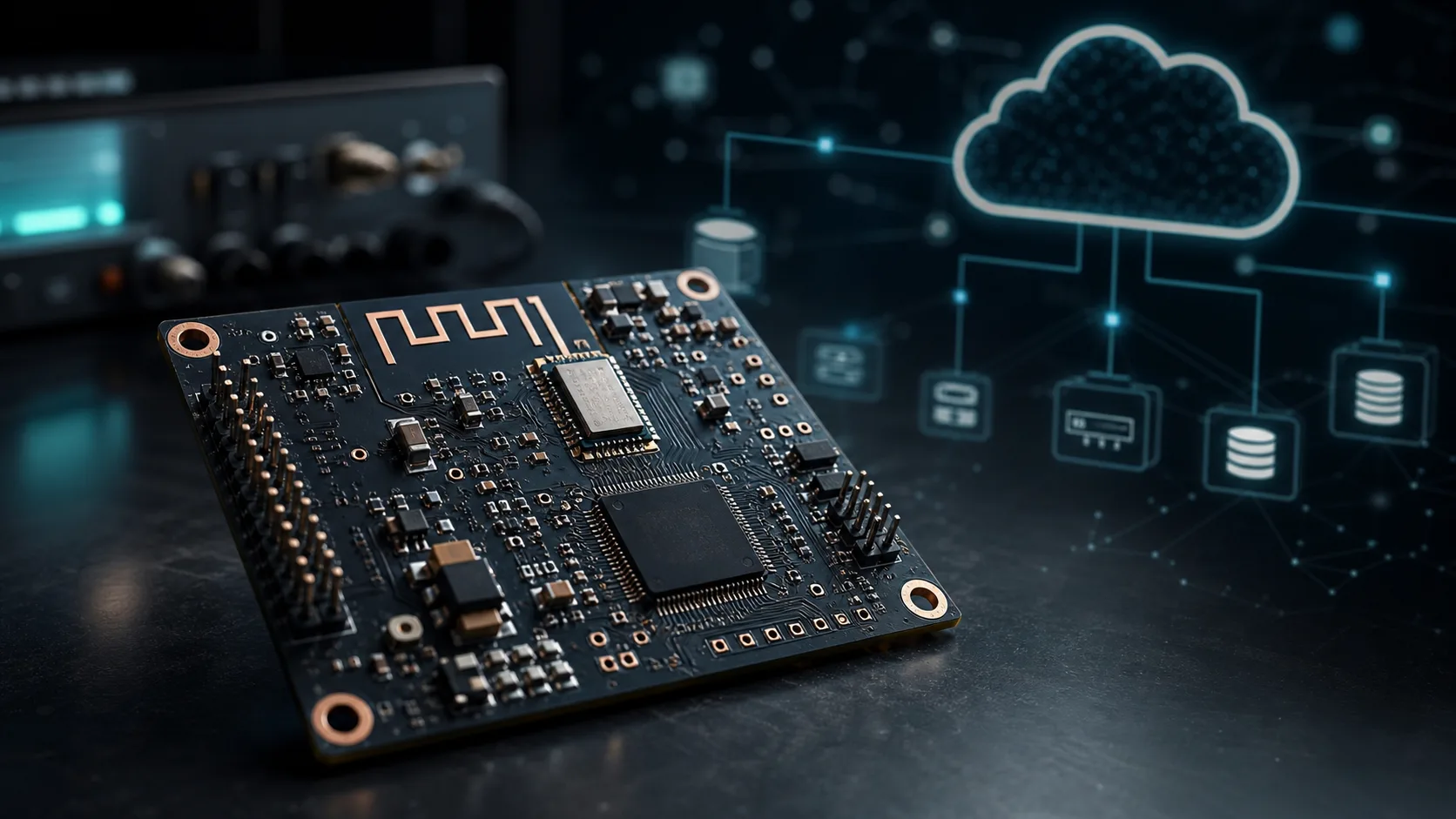
IoT design services span hardware architecture, embedded firmware, wireless connectivity and cloud backend integration – and a gap in any of those layers creates risk that typically surfaces late and costs more to fix than to prevent. This guide is written for founders, engineering managers and product teams evaluating what a capable IoT design partner should deliver, from the first architecture decisions through to a production-ready connected product.
TL;DR
- IoT design services span four layers: hardware architecture, embedded firmware, wireless connectivity, and cloud backend – a gap in any layer creates downstream risk.
- Wireless protocol selection (Wi-Fi, BLE, cellular, LPWAN) should be driven by power budget, data rate, range, and deployment environment – not defaults.
- Firmware and hardware must be co-designed; treating them as separate workstreams is a common cause of schedule blowouts and board respins.
- Cloud architecture for IoT is different from standard web backends – device authentication, MQTT/AMQP messaging, OTA update pipelines, and time-series data storage all require specific design decisions.
- Security needs to be designed in from the start, not retrofitted – key areas include secure boot, encrypted comms, and device identity management.
- An integrated IoT design partner eliminates the handoff gaps between hardware, firmware, and software teams that cause the most expensive IoT project failures.
Why IoT Product Development Is Harder Than It Looks
Building a connected device looks deceptively straightforward on paper: add a wireless module to a circuit, write some firmware, hook it up to a cloud dashboard. In practice, most IoT products that run into trouble do so at the integration points – where hardware meets firmware, where firmware meets wireless, and where the device meets the cloud.
The engineering disciplines involved in a complete IoT product are genuinely different from one another. A PCB designer optimising for signal integrity and EMC compliance is working in a different domain to a firmware engineer writing a real-time sensor sampling loop, who is in turn working differently from a cloud architect designing a device management platform. When these disciplines are siloed across different contractors or teams, the integration cost grows quickly and the risk of a costly redesign rises.
For Australian product companies – hardware startups, industrial businesses, and B2B product teams – this integration risk is the core reason to evaluate IoT design services carefully. The question is not just whether a partner can do hardware or software, but whether they can do both coherently and deliver a product that actually works end to end.
The timelines involved reflect this complexity. According to Intuz’s IoT Product Development Guide (2026), simple IoT solutions typically take 3-6 months to design, build and test, while industrial platforms and complex deployments commonly require 12-18 months. Those ranges assume competent integration across all layers – projects that treat hardware and software as separate workstreams routinely run longer.
What IoT Design Services Should Cover
A complete IoT design service should address all four layers of a connected product. Here is what each layer involves and why it matters.
1. Hardware Architecture
The hardware layer is the foundation. Decisions made here constrain everything above – firmware capability, wireless options, power consumption, cost, and compliance path. Good IoT hardware design requires:
- Microcontroller or microprocessor selection – matched to compute requirements, peripherals needed, power envelope, and component availability. An industrial asset tracker has very different MCU requirements from a consumer wearable.
- Power architecture – battery-operated IoT devices need careful power management design. This includes sleep modes, regulator efficiency, and peak current handling during wireless transmission events.
- Sensor and peripheral integration – each sensor interface (I2C, SPI, UART, ADC) requires careful routing and decoupling. Signal integrity problems here show up later as firmware bugs.
- Antenna design and RF layout – wireless module placement, ground plane clearance, and antenna routing have a direct impact on wireless performance. Many first-time IoT boards underperform in the field because RF layout was treated as an afterthought.
- Compliance planning – EMC, wireless certification (ACMA in Australia, FCC for the US market, CE for Europe), and safety standards need to be factored into the PCB layout from the start. Pre-compliance reviews early in the design save significant time and cost at certification.
Zeus Design’s electronics design service covers the full hardware architecture process, including schematic design, PCB layout, DFM review, and compliance planning for connected products.
2. Embedded Firmware
Firmware is the software that runs directly on the IoT device hardware. It sits between the application logic and the physical hardware, managing peripherals, handling sensor data, controlling wireless communications, and maintaining device state. Key firmware design considerations include:
- RTOS vs bare-metal – whether to use a real-time operating system depends on task complexity and timing requirements. FreeRTOS, Zephyr, and ThreadX are common RTOS choices for IoT devices. Bare-metal is appropriate for simpler, power-constrained applications.
- Hardware abstraction – well-structured firmware separates hardware-specific drivers from application logic, making it easier to port across hardware revisions and test on development boards.
- Wireless stack integration – most wireless modules provide a software stack (for example, Espressif IDF for ESP32-based designs, or Nordic Connect SDK for nRF-based BLE products). Integrating these stacks correctly and managing their resource requirements is a significant portion of IoT firmware work.
- OTA firmware update – the ability to update firmware over the air is nearly mandatory for any connected product. Implementing a reliable OTA pipeline with rollback capability requires deliberate design in both firmware and the cloud backend.
- Power management – firmware controls when the MCU and peripherals sleep and wake. Poor power management firmware can reduce battery life by an order of magnitude compared to a well-optimised design.
Hardware and firmware must be co-designed. A firmware engineer who is involved in hardware schematic review catches potential issues – such as missing pull-ups, wrong GPIO assignments, or inadequate decoupling – before they become board spin problems. Zeus Design’s embedded software development team works alongside the hardware design team for exactly this reason.
3. Wireless Connectivity
Wireless protocol selection is one of the most consequential design decisions in an IoT product. There is no universal right answer – the choice depends on a combination of power budget, data rate, range, network topology, and deployment environment. The main protocol categories for IoT in 2026 are:
| Protocol | Range | Data Rate | Power | Best Fit |
|---|---|---|---|---|
| Wi-Fi 6 | 50-100 m indoors | High (Mbps+) | High | Mains-powered, high-throughput, existing network infrastructure |
| Bluetooth Low Energy (BLE) | Up to 100 m | Low-medium (kbps) | Very low | Wearables, proximity sensing, smartphone-paired devices |
| Zigbee / Thread / Matter | 10-100 m mesh | Low | Low | Smart home, building automation, mesh sensor networks |
| LTE-M / NB-IoT | Cellular (km+) | Low-medium | Medium-low | Battery-operated field devices, asset tracking, remote monitoring |
| LoRaWAN | 2-15 km | Very low (bps-kbps) | Very low | Agricultural, industrial, infrastructure sensing with infrequent small payloads |
For many Australian industrial and agricultural IoT applications, cellular LPWA technologies (LTE-M or NB-IoT) or LoRaWAN are the practical choices where devices operate far from Wi-Fi infrastructure. Consumer and commercial building products more commonly use Wi-Fi or BLE. Refer to the Bluetooth SIG’s technology comparison and Cavli Wireless’s interface guide for deeper technical reference on protocol selection.
Protocol selection also drives compliance requirements. Wireless products sold in Australia require ACMA compliance (RCM marking). Products using Wi-Fi or BLE built on certified modules can leverage module certifications to reduce the scope of device-level testing. Custom RF designs require full regulatory testing. This compliance path needs to be planned during hardware architecture, not after the board is built.
Zeus Design’s IoT connectivity capability covers wireless protocol selection, RF layout, module integration, and compliance planning as part of the hardware design process.
4. Cloud Backend Integration
The cloud backend is where IoT devices send their data, receive commands, get firmware updates, and are managed at scale. Designing a cloud backend for IoT is different from designing a standard web application backend. Key differences include:
- Device connectivity protocols – IoT devices typically communicate using MQTT or AMQP rather than HTTP, because these protocols are lightweight, support persistent connections, and handle unreliable networks better. AWS IoT Core, Azure IoT Hub, and Google Cloud IoT are the leading managed platforms that implement these protocols at scale.
- Device identity and authentication – each device needs a unique identity and credentials. X.509 certificates or shared access signatures are common approaches. Provisioning device identities at manufacture (rather than in the field) reduces deployment friction and improves security.
- Time-series data storage – IoT data is inherently time-stamped and high-volume. Standard relational databases are often a poor fit. Time-series databases (InfluxDB, TimescaleDB) or cloud-native stores (AWS Timestream, Azure ADX) are better matched to IoT data patterns.
- OTA update infrastructure – the cloud backend needs to host firmware images, manage rollout policies, track device versions, and handle rollback for failed updates.
- Real-time vs batch processing – some IoT applications need real-time alerting (anomaly detection, threshold breaches), while others only need periodic batch analytics. The backend architecture needs to accommodate the right processing model.
Refer to Google Cloud’s IoT platform architecture guide for a solid reference on the key architectural considerations for production IoT cloud backends.
Zeus Design’s cloud development and mobile app development teams build the backend services and companion apps that make IoT devices useful to end users – dashboards, alerting, remote configuration, and data export pipelines.
Security Across All Four Layers
IoT security is not a feature to add at the end – it is a design discipline that runs through every layer of the stack. The consequences of poor IoT security are serious: devices can be hijacked and used in botnets, sensitive sensor data can be exposed, and firmware can be tampered with. The BugProve IoT firmware security reference identifies secure boot, encrypted communications, and device identity management as the three foundational controls that must be designed in at the hardware and firmware level – not retrofitted after production. Key security design considerations include:
- Secure boot – the device should verify the integrity and authenticity of its firmware before executing it. This requires a hardware root of trust (most modern MCUs provide this) and a signing key infrastructure.
- Encrypted communications – all data in transit between the device and cloud should use TLS 1.2 or later. Certificate pinning adds an additional layer of protection against man-in-the-middle attacks.
- Device identity management – each device should have a unique, non-shareable identity. Shared credentials across a fleet are a significant security risk.
- Secure OTA updates – firmware update packages should be signed, verified on-device before application, and delivered over encrypted channels.
- Physical security – for devices in the field, consider JTAG/debug port disabling in production firmware, tamper detection, and secure storage for cryptographic keys (hardware security modules or dedicated secure elements).
When to Engage IoT Design Services
Engaging an external IoT development partner makes most sense when your product has any of the following characteristics:
- The device needs to communicate wirelessly with a cloud backend or companion app.
- Your team has strong software capability but limited experience in electronics design, PCB layout, or RF.
- Your team has strong hardware experience but limited embedded software or cloud backend depth.
- You need a production-ready product, not just a prototype that works on the bench.
- Regulatory compliance (ACMA, FCC, CE, safety standards) is required for your target market.
- You are building in a domain with specific reliability or safety requirements – industrial, medical, agricultural, or infrastructure.
Early engagement with an IoT design partner – ideally at the requirements and architecture phase – produces better outcomes than engaging after hardware has already been designed or a prototype has already been built on off-the-shelf modules. See Zeus Design’s guide to IoT development from hardware to cloud for more on how the full development process is structured.
What to Look for in an IoT Design Partner
Evaluating a potential IoT partner requires asking questions across all four layers. Ask these when assessing candidates:
- Can they show examples of products they have taken from schematic to production, including firmware and cloud integration?
- Do they have experience with the wireless protocol relevant to your application (BLE, Wi-Fi, cellular, LoRaWAN)?
- How do they handle hardware-firmware co-design? Are the hardware and firmware teams integrated or siloed?
- What is their compliance track record – have they successfully taken products through ACMA, FCC, or CE certification?
- What cloud platforms do they work with (AWS IoT, Azure IoT, GCP)?
- How do they approach OTA firmware update design?
- Can they design the companion mobile app as well as the device and backend?
For Australian product teams, working with a local IoT design partner has practical advantages: time-zone alignment for design reviews, familiarity with ACMA compliance requirements, and the ability to support on-site testing and prototyping iteration. Zeus Design delivers this integrated capability – from PCB and circuit board design through firmware and cloud – operating from Australia.
Zeus Design’s IoT Design Process
Zeus Design’s approach to IoT product development is built around reducing integration risk across hardware, firmware, and software. Every IoT engagement follows six phases:
- Requirements and architecture review – mapping product requirements to hardware architecture choices, wireless protocol selection, and cloud backend approach. This is the phase where most critical decisions are made, and where early engagement has the highest leverage.
- Hardware design – schematic capture, PCB layout, signal integrity and EMC-aware design, component selection, and DFM review. RF layout and antenna design are integrated into the hardware design phase, not added later.
- Firmware development – developed alongside hardware design. Firmware engineers review schematics before layout is finalised, catching interface and timing issues early. Wireless stack integration, power management, and OTA infrastructure are core firmware deliverables.
- Prototyping and validation – functional prototypes are built and tested against the product requirements. Wireless range testing, power consumption measurement, and compliance pre-testing are carried out at this stage.
- Cloud backend and app development – backend services, device management infrastructure, APIs, dashboards, and companion mobile apps are built and integrated with the device firmware.
- Compliance and production readiness – final compliance testing, DFM review, test jig development, and production documentation are prepared before handover to manufacture.
FAQs
What do IoT design services typically include?
IoT design services cover hardware architecture (PCB design, component selection, RF layout), embedded firmware development, wireless connectivity integration, and cloud backend design. A complete service should also include compliance planning, OTA firmware update infrastructure, and optionally companion mobile app development. The breadth of what is included varies significantly between providers – a specialist focused only on hardware will not cover cloud integration.
How do I choose the right wireless protocol for my IoT product?
Protocol selection depends on your power budget, data rate requirements, range, network topology, and deployment environment. Wi-Fi suits mains-powered devices on existing networks; BLE suits smartphone-paired or low-power short-range applications; LTE-M and NB-IoT suit battery-operated devices operating without local network infrastructure; LoRaWAN suits low-data-rate sensors over long distances. Your IoT design services partner should guide this decision based on your specific product requirements, not defaults.
Why does IoT development cost more than a standard software project?
IoT products involve hardware, firmware, wireless, and cloud engineering disciplines simultaneously. Hardware requires tooling (PCB fabrication, assembly) and compliance testing that pure software projects do not. Firmware development is constrained by hardware, making iteration slower than web or mobile software. Wireless certification (ACMA, FCC, CE) adds cost and time. And the integration work between all four layers is significant. For a realistic IoT project budget, see Zeus Design’s post on IoT device design and costs.
What cloud platforms are used for IoT backends?
AWS IoT Core, Azure IoT Hub, and Google Cloud IoT are the three major managed cloud platforms for IoT. They handle device connectivity (MQTT/AMQP), device identity and authentication, and provide hooks into the broader cloud ecosystem for storage, analytics, and application development. Some products use custom MQTT brokers or lightweight platforms like Mosquitto for simpler deployments. Platform choice should be driven by your scale, existing cloud infrastructure, and long-term cost model.
Can Zeus Design handle the full IoT stack – hardware, firmware, and cloud?
Yes. Zeus Design covers the full connected-device stack: electronics design and PCB layout, embedded firmware, wireless connectivity integration, cloud backend development, and companion mobile app development. Working with a single partner across all layers reduces integration risk and eliminates the handoff problems that arise when hardware and software teams are separate. Contact Zeus Design to discuss your project requirements.
How long does it take to develop an IoT product from concept to production?
Timeline varies significantly with product complexity. A simple sensor product with a standard wireless module and basic cloud integration might take 4-6 months from concept to functional prototype, with another 2-4 months for compliance, DFM, and production setup. Complex industrial IoT products with custom RF design, safety certification, and enterprise cloud integration typically take 12-18 months. Early architectural decisions – including wireless protocol and cloud platform – have a significant impact on overall timeline.
What compliance requirements apply to IoT products in Australia?
IoT products sold in Australia must comply with ACMA regulations covering electromagnetic compatibility (EMC) and radio communications. Products with wireless interfaces (Wi-Fi, Bluetooth, cellular) require RCM marking. Products using certified wireless modules can leverage module certifications to reduce device-level testing scope, but the overall product still requires compliance assessment. Products for specific industries (medical, industrial safety) may also face additional regulatory requirements.
Conclusion
The real risk in an IoT project is rarely a single engineering problem. It is the gaps between hardware, firmware, wireless, and cloud – the integration points that no single specialist owns and that no one manages unless the team is built to handle them together.
For product teams evaluating an IoT design partner, the most important question is whether the partner can work coherently across all four layers, or whether they will be managing the integration risk themselves. An integrated team that co-designs hardware and firmware, selects wireless protocols based on real system requirements, and builds a cloud backend designed for IoT (not adapted from a web application) significantly reduces the risk of costly redesigns and field failures.
Zeus Design works with Australian hardware startups, product companies, and engineering teams on IoT products from the first architecture review through to production-ready hardware and cloud infrastructure. If you are planning a connected device and want to discuss requirements, contact Zeus Design to start the conversation.




0 Comments