
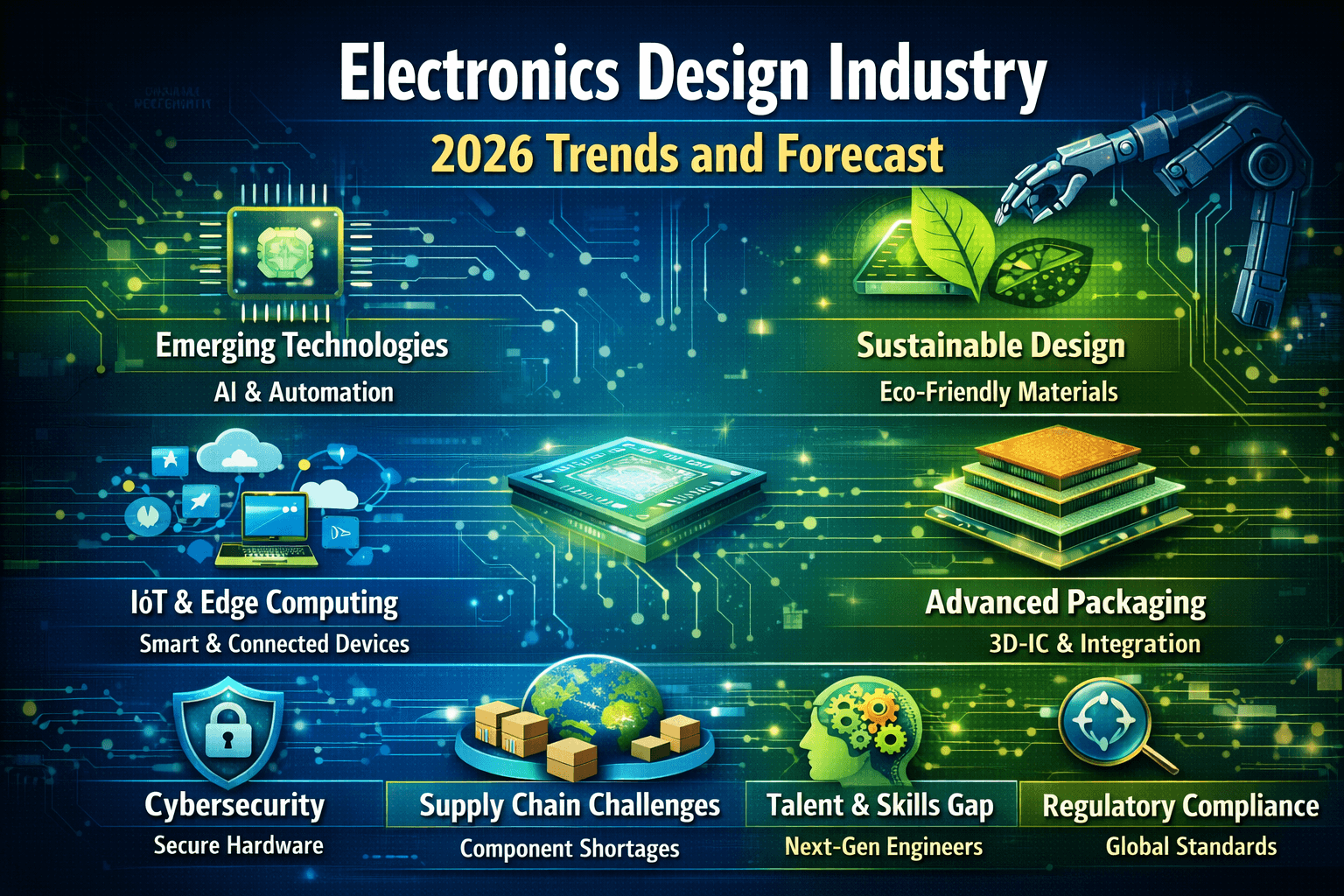
The electronics design industry is entering a defining period. By 2026, accelerating technological innovation, tighter regulations, and shifting global supply chains are reshaping how electronic products are conceived, developed, and brought to market. For established businesses and startups alike, electronics design is no longer just a technical function—it is a strategic capability that directly influences competitiveness, sustainability, and time-to-market.
This article explores the key electronics design trends expected to dominate in 2026, alongside a practical forecast to help organisations plan their design, engineering, and investment strategies with confidence.
Introduction to the Electronics Design Industry in 2026
Electronics design sits at the heart of modern innovation, underpinning industries from automotive and healthcare to industrial automation and consumer technology. As products become more intelligent, connected, and compact, design complexity continues to rise.
By 2026, electronics design teams will be working in an environment defined by rapid iteration, increased digitalisation, and heightened expectations for reliability and security. The role of the electronics designer is evolving from circuit implementation to system-level problem-solving, balancing performance, cost, sustainability, and compliance from the earliest design stages.
Market Overview and Economic Forecast
The global electronics design market is forecast to experience steady growth through 2026, driven by demand for smart devices, electrification, and digital infrastructure. Investment in electronics design services is increasing as companies seek specialist expertise to manage complex requirements without expanding internal teams excessively.
Key growth sectors include electric vehicles, renewable energy systems, medical devices, and industrial IoT. At the same time, economic uncertainty and fluctuating component availability are encouraging businesses to prioritise robust, adaptable design approaches that can withstand market disruption.
Emerging Technologies Transforming Electronics Design
Technology innovation continues to redefine electronics design workflows. Artificial intelligence is being integrated into design automation tools, supporting tasks such as component placement, routing optimisation, and fault detection. These capabilities allow engineers to explore more design options in less time, improving performance while reducing development cycles.
Cloud-based design platforms are also becoming mainstream, enabling distributed teams to collaborate in real time. This shift supports global development models and improves design continuity from concept through to manufacturing.
Sustainable Electronics Design as a Core Industry Driver
Sustainability is no longer optional in electronics design. By 2026, environmental considerations are expected to influence nearly every design decision, from material selection to power consumption and product lifespan.
Design teams are increasingly focused on energy efficiency, reduced material usage, and recyclability. Regulations targeting electronic waste and carbon emissions are pushing manufacturers to adopt lifecycle-based design strategies, ensuring products can be repaired, upgraded, or recycled more easily. For businesses, sustainable electronics design is becoming both a compliance requirement and a competitive differentiator.
IoT and Edge Computing Influences on Product Design
The continued expansion of IoT and edge computing is placing new demands on electronics design. Devices must process data locally, operate reliably in diverse environments, and maintain secure connectivity—all while consuming minimal power.
This is driving innovation in low-power architectures, advanced sensors, and compact form factors. Electronics designers are increasingly required to understand software and data requirements, ensuring hardware platforms can support evolving firmware and analytics capabilities throughout a product’s lifecycle.
Advanced Packaging and System Integration Trends
As performance requirements increase and form factors shrink, advanced packaging techniques are becoming critical. Multi-chip modules, system-in-package solutions, and heterogeneous integration are enabling higher functionality within smaller footprints.
By 2026, electronics design teams will need deeper expertise in thermal management, signal integrity, and electromagnetic compatibility. Early collaboration between electronics, mechanical, and manufacturing teams is essential to ensure these advanced integrations deliver reliable, manufacturable products.
Simulation, Modelling, and Virtual Prototyping Adoption
Simulation and virtual prototyping are now central to modern electronics design. Instead of relying heavily on physical prototypes, teams are using advanced modelling tools to validate performance, reliability, and compliance early in the design process.
Digital simulation reduces development risk, shortens time-to-market, and lowers costs by identifying issues before hardware is built. In 2026, companies that invest in simulation-driven design are expected to outperform competitors still reliant on traditional trial-and-error approaches.
Supply Chain Challenges and Design Resilience Strategies
Recent years have highlighted the vulnerability of global electronics supply chains. Component shortages and long lead times have forced design teams to rethink how they select and qualify parts.
By 2026, resilient electronics design will involve multi-sourcing strategies, component lifecycle analysis, and greater use of programmable or flexible architectures. Designers will work closely with procurement and manufacturing partners to ensure designs remain viable even when preferred components become unavailable.
Custom Electronics Design Versus Off-the-Shelf Solutions
The decision between custom electronics design and off-the-shelf solutions remains a critical strategic choice. While commercial components can reduce development time, they may limit differentiation, scalability, or long-term availability.
Custom electronics design is increasingly attractive for companies seeking performance optimisation, IP ownership, or long product lifecycles. In 2026, many organisations will adopt hybrid approaches, combining standard components with bespoke design elements to balance speed, cost, and innovation.
Cybersecurity as a Design Requirement
Cybersecurity is now a fundamental requirement in electronics design, not an afterthought. Connected devices present potential entry points for attacks, making secure hardware design essential.
By 2026, secure boot mechanisms, hardware encryption, and tamper resistance will be standard features in many products. Electronics designers must collaborate closely with software and security teams to implement defence-in-depth strategies that protect devices throughout their operational life.
Skills, Talent, and Workforce Evolution in Electronics Design
The electronics design industry faces a growing skills gap. Demand for engineers with expertise in advanced design tools, embedded systems, and cross-disciplinary development is outpacing supply.
To address this, businesses are investing in upskilling, automation, and partnerships with specialist design consultancies. In 2026, successful organisations will be those that treat talent development as a long-term strategic priority rather than a short-term hiring challenge.
Regulatory and Compliance Trends Affecting Electronics Design
Regulatory complexity continues to increase, with electronics design teams required to navigate safety, environmental, and industry-specific standards across multiple markets. Compliance considerations now influence architecture decisions from the earliest design stages.
By embedding compliance into the design process, companies can reduce certification delays and avoid costly redesigns. In 2026, proactive compliance management will be a key factor in achieving faster and more predictable product launches.
Business Models and Innovation Strategies in 2026
Electronics design is increasingly integrated into broader innovation strategies. Companies are forming partnerships with design houses, technology providers, and manufacturers to accelerate development and share risk.
Agile development models and modular design approaches are becoming standard, allowing businesses to respond quickly to market changes. In 2026, electronics design excellence will be closely linked to organisational agility and strategic alignment.
Industry Examples and Practical Applications
Across sectors, leading companies are already applying these trends. In automotive electronics, scalable platforms support rapid model variation. In healthcare, low-power and secure designs enable portable diagnostic devices. In industrial systems, robust and upgradeable electronics extend product lifecycles and reduce downtime.
These examples highlight how forward-thinking electronics design strategies translate directly into commercial and operational advantages.
Future Outlook for the Electronics Design Industry Beyond 2026
Looking beyond 2026, electronics design will continue to converge with software, data, and systems engineering. Advances in materials, automation, and AI-assisted design promise further productivity gains, while sustainability and security will remain central priorities.
Organisations that build flexible, future-ready design capabilities will be best positioned to adapt as technologies and markets evolve.
Conclusion: Strategic Takeaways for Electronics Design Leaders
The electronics design industry in 2026 will be defined by complexity, opportunity, and transformation. Success will depend on adopting advanced tools, embracing sustainability, strengthening supply chain resilience, and investing in skills and collaboration.
For established businesses and startups alike, electronics design is no longer just about building circuits—it is about designing systems that are resilient, secure, sustainable, and ready for the future. By aligning design strategy with these emerging trends, organisations can turn technological change into long-term competitive advantage.




0 Comments