Electromagnetic interference (EMI) failures are rarely random. In most cases, they are the direct result of preventable PCB design decisions made months earlier.
For established businesses, an EMI failure means delayed product launches, damaged brand credibility and unexpected re-spins. For startups, it can mean burned runway and missed investor milestones. The uncomfortable truth? Most EMI problems are designed into the board long before compliance testing.
If you’re developing electronics products, here are the most common PCB design mistakes that trigger EMI failures — and how to eliminate them early.
Introduction to EMI in PCB Design
Electromagnetic interference occurs when unwanted electromagnetic energy disrupts circuit operation or exceeds regulatory emission limits. Every PCB radiates. The question is whether it radiates within acceptable limits.
Modern products combine:
Fast switching regulators
High-speed digital interfaces
Dense layouts
Multiple power domains
Without deliberate design for EMI control, emissions are inevitable.
Compliance testing (CE, FCC, CISPR) doesn’t “fix” EMI. It simply measures how well you designed against it.
Poor Stack-Up Planning
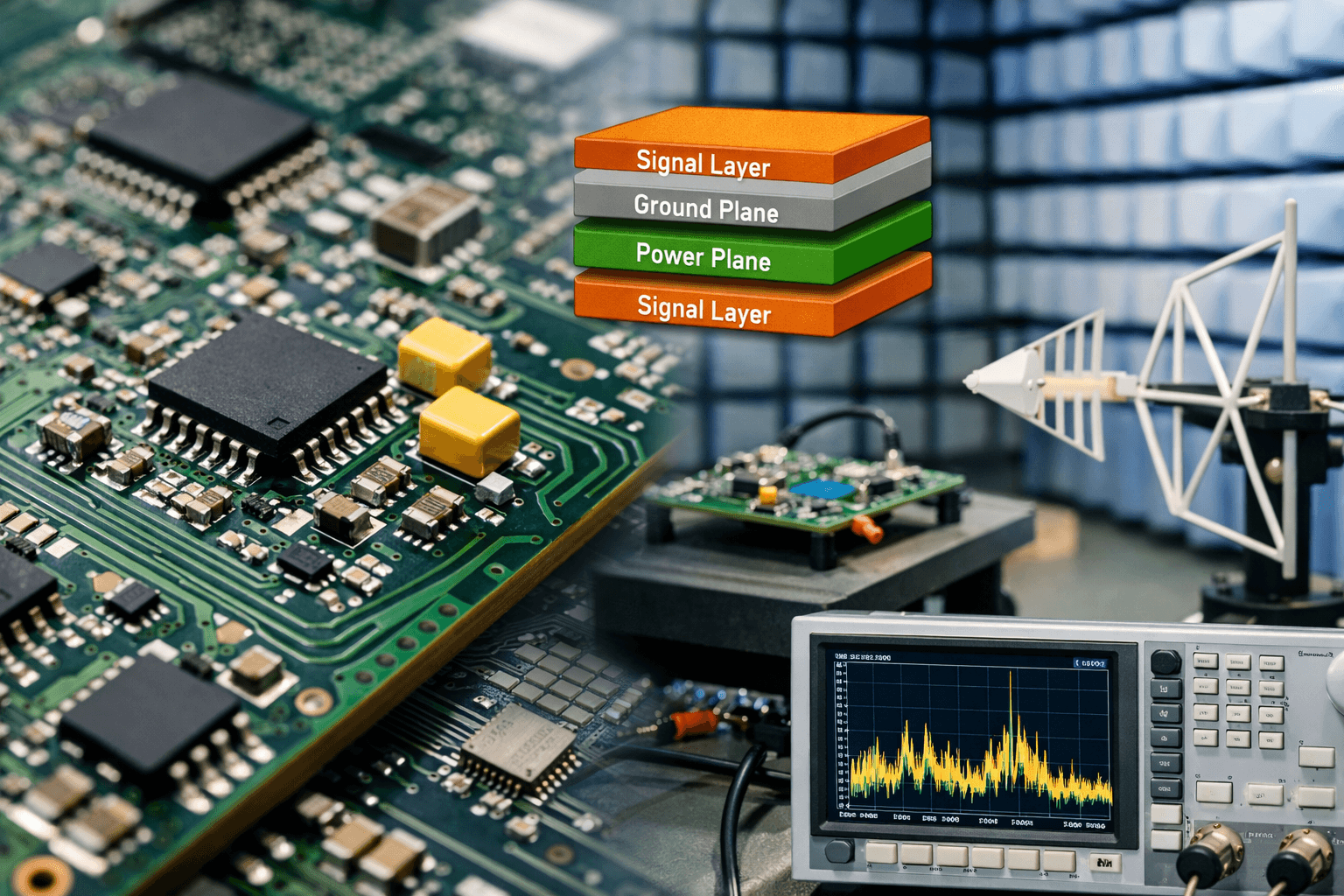
Your PCB stack-up is the foundation of EMI performance. If it’s wrong, no amount of filtering will save you.
Inadequate Ground and Power Plane Configuration
A common mistake is treating stack-up as a manufacturing detail instead of an electrical design decision.
A robust stack-up typically includes:
Continuous reference planes adjacent to signal layers
Tight coupling between power and ground planes
Symmetry to reduce warping and impedance variation
Without proper reference planes, return currents spread unpredictably, increasing loop area and radiated emissions.
Missing Dedicated Return Paths
High-frequency currents always take the path of least impedance — not least resistance. If you don’t provide a clear return path directly under the signal trace, the current will find one. That detour increases radiation.
How Layer Order Impacts Radiated Emissions
Signals routed next to solid ground planes produce significantly lower EMI than those routed over split planes or thin pours. Stack-up decisions directly control field containment.
Broken or Fragmented Ground Planes
A solid ground plane is your best EMI suppression tool — and designers routinely break it.
Why Continuous Ground Planes Matter
Ground planes:
Provide low-impedance return paths
Reduce loop area
Contain electric fields
Lower impedance at high frequencies
Cut that plane, and you force return currents to reroute.
The Hidden Danger of Plane Splits
Splitting analogue and digital grounds without understanding return current behaviour often increases EMI instead of reducing it. High-frequency currents do not respect your labelling.
High-Frequency Return Current Behaviour
At high frequencies, return current flows directly under the signal trace. If a gap exists, the current detours — forming a large loop antenna.
Excessive Loop Areas in Signal Routing
Loop area equals radiation. This is not optional physics.
Loop Area and Magnetic Field Radiation
Any current loop generates a magnetic field. Increase the loop area and emissions increase proportionally.
Typical causes:
Poor trace-to-ground referencing
Long signal runs without nearby return
Connector transitions without stitching vias
Poor Placement of Return Paths
Routing a signal across layers without stitching vias to maintain reference continuity creates discontinuities — prime radiation points.
Reducing Loop Area in High-Speed Designs
Keep:
Signals close to reference planes
Via transitions tightly stitched
Power loops (especially switching regulators) extremely compact
Improper Decoupling and Bypass Capacitor Placement
You can choose the perfect capacitor value and still fail EMI.
Why Placement Matters More Than Value
A decoupling capacitor placed 20 mm away from the IC is ineffective at high frequencies. Inductance dominates.
Place capacitors:
As close as physically possible to power pins
With minimal loop area
With short, wide connections to ground
High-Frequency Current Demands
Digital ICs draw sharp current spikes. If local decoupling is poor, those spikes travel across the board, turning planes into radiating surfaces.
Common Decoupling Layout Errors
Long thin traces
Shared vias for multiple capacitors
Routing before placing capacitors
Placement must come first.
Long High-Speed Trace Routing
Fast edges create broadband emissions.
Transmission Line Effects and EMI
Once trace length approaches a fraction of the signal rise time wavelength, it behaves as a transmission line. Reflections increase ringing. Ringing increases emissions.
Uncontrolled Impedance Problems
Ignoring impedance control leads to:
Reflections
Overshoot
Increased spectral content
This directly impacts EMI performance.
Minimising Radiation from Fast Edges
Control impedance
Use proper terminations
Shorten trace length
Avoid unnecessary stubs
Poor Component Placement Strategy
EMI control begins with placement — not routing.
Functional Zoning Principles
Partition the board into:
Noisy power section
Digital processing section
Sensitive analogue section
I/O interface zone
Don’t scatter these randomly.
Separating Noisy and Sensitive Circuits
Switching regulators next to analogue front ends is a predictable failure mode.
Early-Stage EMI Planning
If EMI is considered after routing, it’s too late. Placement must reflect current flow paths from day one.
Inadequate Grounding of Connectors and Cables
Cables are antennas. Full stop.
Cables as Unintentional Antennas
Any high-frequency noise reaching a cable can radiate efficiently. Poor connector grounding makes compliance nearly impossible.
Shield Termination Best Practices
Shield terminations should:
Bond 360° to chassis ground
Minimise pigtails
Avoid long ground wires
Chassis Ground vs Signal Ground Confusion
Improper bonding between chassis and signal ground creates unintended current paths.
Lack of Controlled Impedance Design
At higher data rates, this is not optional.
Why Impedance Mismatch Increases Emissions
Reflections increase voltage peaks and ringing, generating higher harmonics.
Differential Pair Routing Errors
Common mistakes:
Unequal trace lengths
Poor spacing control
Crossing plane splits
The Role of PCB Stack-Up Calculations
Impedance depends on:
Dielectric thickness
Trace width
Copper thickness
Plane proximity
If you didn’t calculate it, you don’t control it.
Ignoring Power Integrity
Power integrity and EMI are inseparable.
Switching Regulators as EMI Sources
Fast switching edges and high di/dt loops are primary emission sources.
Minimise:
Hot loop area
Gate drive trace length
Input capacitor distance
Poor Power Plane Layout
Large uninterrupted noisy power areas radiate more than tightly coupled planes.
Managing Ripple and Transient Noise
Ripple currents must be contained locally. If they spread, emissions increase.
Incorrect Use of Ground Fills and Stitching Vias
More copper is not automatically better.
When Copper Pours Make Things Worse
Floating copper islands act as antennas. If a ground fill is not well connected, remove it.
Via Fencing for Emission Control
Stitching vias around board edges and high-speed areas help contain fields and reduce edge radiation.
Edge Radiation Prevention Techniques
Fields tend to escape at PCB edges. Via stitching and tight plane coupling reduce leakage.
Overlooking Signal Rise and Fall Times
Frequency is not the only factor — edge rate matters more.
Why Fast Edges Cause EMI Problems
A 10 MHz clock with 1 ns edges contains frequency components far beyond 10 MHz.
Slew Rate Control Techniques
Where possible:
Slow down edges
Use series resistors
Select drivers with controlled rise times
Termination Strategies That Reduce Emissions
Proper termination reduces ringing and spectral spread.
Poor Isolation Between Analogue and Digital Sections
Mixed-signal boards are particularly vulnerable.
Mixed-Signal PCB Challenges
Digital noise coupling into analogue circuits leads to both functional and compliance failures.
Proper Partitioning Without Splitting Planes
Avoid unnecessary ground splits. Instead:
Use placement zoning
Control return paths
Use filtering at boundaries
Managing High-Frequency Coupling
Short return paths and careful routing reduce cross-domain interference.
Neglecting Pre-Compliance Testing
Waiting for official lab testing is financially reckless.
Why Lab Testing Shouldn’t Be the First EMI Check
By the time you reach formal testing:
Tooling is paid
Firmware is stable
Marketing has launch dates
A failure here is expensive.
Cost Implications of Late Discovery
A single PCB re-spin can cost:
Engineering time
Manufacturing delay
Lost opportunity
Practical Pre-Compliance Strategies
Near-field probing
Bench-level spectrum analysis
Early radiated emission scans
Designing Without EMC Standards in Mind
Compliance is not a post-design activity.
Key Standards Overview
Depending on your market, you’ll likely face:
CE requirements
FCC regulations
CISPR emission limits
Each defines acceptable emission levels.
Design for Compliance from Day One
Understand your target market before layout begins. Design margins into your architecture.
Building EMI Resilience Into Your Development Process
Create internal design reviews focused specifically on:
Return paths
Loop areas
Power integrity
Connector grounding
Practical EMI Design Checklist for Engineering Teams
Before release to manufacturing:
Verify stack-up and reference planes
Inspect return path continuity
Confirm decoupling placement
Review switching regulator layout
Check impedance calculations
Validate shielding and connector grounding
Conduct pre-compliance scans
If these steps aren’t formalised, EMI failures become likely rather than possible.
Conclusion: Designing PCB Layouts That Pass EMI First Time
EMI failures are rarely mysterious. They are usually the result of overlooked fundamentals in PCB design.
For startups, EMI mistakes consume runway. For established companies, they delay revenue and damage credibility. In both cases, prevention is cheaper than correction.
The strategic approach is simple:
Design stack-up intentionally
Control return paths
Minimise loop areas
Contain switching currents
Test early
EMI performance is not about adding filters at the end. It’s about designing intelligently from the first schematic capture.
If your organisation treats EMI as a late-stage hurdle rather than a design discipline, that’s the blind spot.
Fix that — and your next product stands a far better chance of passing first time.




0 Comments