An electronics design house is a specialist engineering firm that owns the full technical scope of hardware product development – circuit design, PCB layout, firmware, compliance planning and production handover – under one roof. This guide is for founders, product managers and engineering leads deciding whether a design house fits their project, and what separates a capable partner from a risky one.
TL;DR
- An electronics design house handles end-to-end hardware development: schematics, PCB layout, firmware, DFM, compliance and often software integration.
- It is different from a contract manufacturer (which builds to your spec) and a freelancer (who covers a narrow scope independently).
- The right design house reduces risk by combining engineering breadth with project continuity – one team owns the design from concept to production handover.
- Key evaluation criteria: relevant domain experience, engineering team depth, IP ownership terms, DFM knowledge, firmware capability, compliance awareness and post-project support.
- Zeus Design is an Australian electronics design house offering electronics design, PCB layout, embedded software, IoT connectivity and software development as an integrated service.
The Problem These Partners Solve
Most hardware product teams hit the same wall: building in-house electronics engineering capability is expensive and slow, but stitching together freelancers introduces coordination risk, inconsistent quality and knowledge gaps at the handover points that matter most – DFM, firmware integration and compliance.
A contract manufacturer solves a different problem. An EMS (Electronics Manufacturing Services) provider builds your board to spec, but does not produce the design. They need a Gerber package, a BOM, a pick-and-place file and a test plan before they can start. If those files contain errors, rework costs fall on you.
An electronics design house sits between concept and production. It produces the design the manufacturer will build – and a good one does that with production constraints in mind from the first schematic revision.
What an Electronics Design House Does
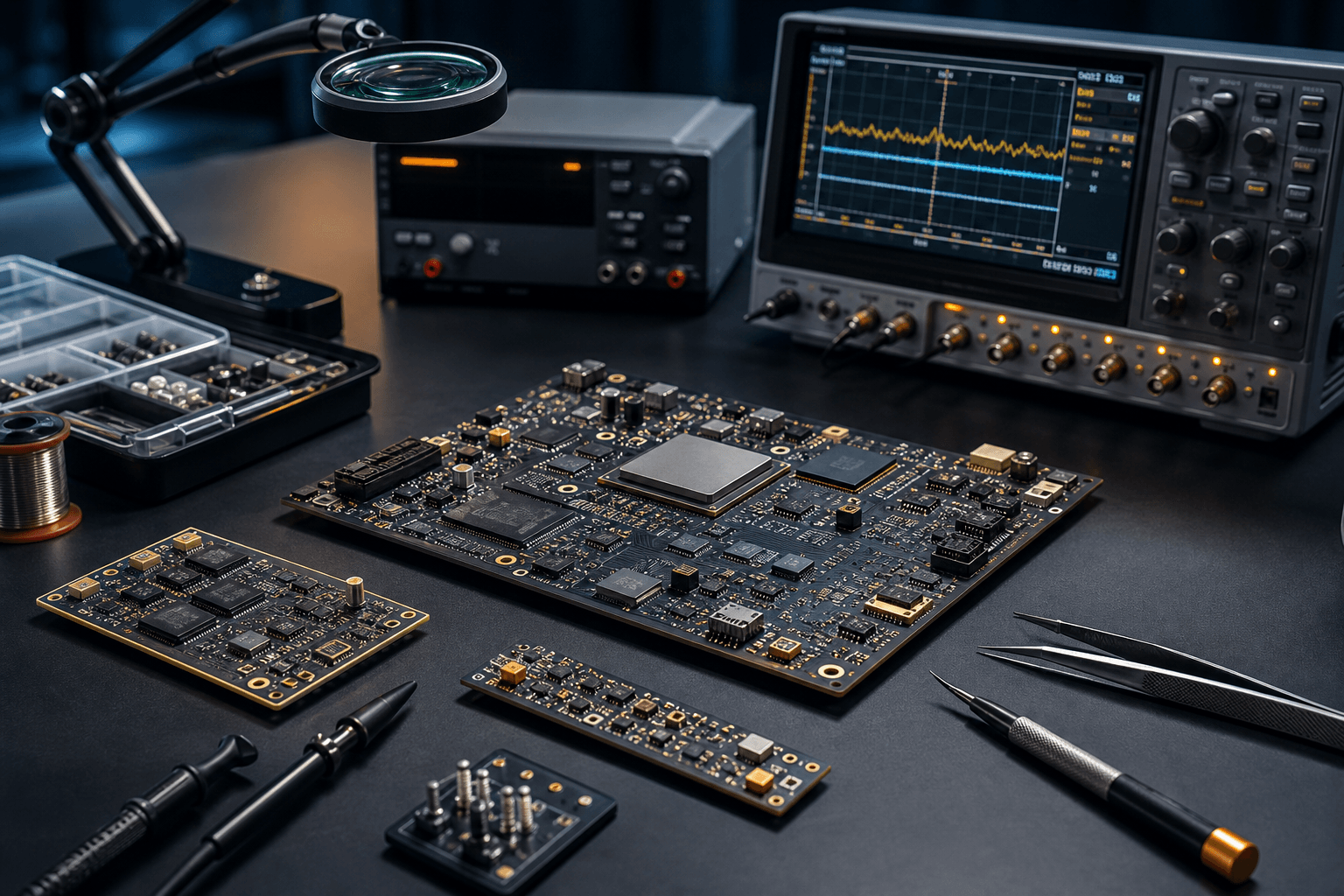
A design house covers the engineering work required to turn a product idea into a manufacturable electronic device. That scope typically includes:
- Requirements and architecture – translating a product brief into a technical specification: voltage rails, processing requirements, connectivity, operating environment and reliability targets.
- Circuit and schematic design – analog and digital circuit design, component selection, power architecture and signal routing decisions that determine whether the product will work reliably in the field.
- PCB layout – translating schematics into a manufacturable board: layer stack-up, component placement, trace routing, impedance control, EMC-aware layout and design rule compliance.
- Rapid prototyping – early functional builds to validate concepts, test subsystems and iterate before committing to a production-intent design.
- Embedded firmware – microcontroller and RTOS firmware development, hardware abstraction layers, driver development and over-the-air update architecture where required.
- Design for manufacture (DFM) – reviewing and revising the design with the manufacturer’s process constraints in mind to improve yield, reduce assembly cost and prevent production surprises.
- Compliance and certification support – designing to relevant standards (EMC, electrical safety, wireless type approval) so the product does not fail certification after production tooling has been cut.
- Test system development – production test fixtures and jigs that allow the manufacturer to verify every unit before it ships.
- Production handover – structured transfer of design files, firmware source, BOM, test procedures and manufacturing documentation to the CM.
Broader design houses also extend into software development, mobile app development and cloud backend integration – important for IoT and connected product projects where the hardware and software need to be designed together.
Design House vs Freelancer vs Contract Manufacturer
These three models are often conflated, but they serve different needs at different stages. Getting the distinction right determines how you structure your engagement and who owns what.
| Model | What they do | Typical scope | Best fit |
|---|---|---|---|
| Electronics design house | End-to-end engineering: design, firmware, DFM, compliance, handover | Full product development cycle | New product development, startups, teams without in-house EE capability |
| Freelance engineer | Individual contributor on a defined task: schematic, layout or firmware | Narrow, task-based | Augmenting an existing in-house team on a specific deliverable |
| Contract manufacturer (EMS/CM) | Builds to your design specification: procurement, assembly, test | Manufacturing and production | Scaling a validated, production-ready design |
The practical risk with freelancers on a full product development project is knowledge fragmentation. A PCB layout freelancer and a firmware freelancer working independently rarely optimise the design as a system. DFM gaps, integration bugs and compliance surprises tend to emerge at the worst possible time – during prototype testing or pre-certification review.
Contract manufacturers are not design partners. Sending a design with DFM problems to a CM results in rework costs, yield problems and delayed production. According to MacroFab’s DFM guidelines, design issues caught in the layout phase cost orders of magnitude less to resolve than those found after assembly.
What a Good Electronics Design House Delivers
The task list above describes what a design house does. What follows are the structural commitments that separate a genuine partner from a group of engineers who happen to share an office:
Intellectual Property Ownership
You pay for the work; you own the outputs. A professional design house operates on work-for-hire terms – schematics, Gerber files, firmware source code and test documentation transfer to you at project completion. Confirm this in the contract before work starts. IP clarity matters most when you intend to raise investment, license the product, or switch manufacturers.
DFM-Aware Design from Day One
Design for manufacture is not a final review step – it is a design discipline that begins at schematic stage. Component selection, footprint choices, layer count, via sizes and test point placement all affect assembly yield. A design house with manufacturing experience builds these constraints in from the start rather than retrofitting them before handover. Zeus Design’s electronics design service covers DFM alongside circuit design as part of the standard engagement.
Firmware and Hardware Developed Together
Firmware bugs rooted in hardware design decisions – GPIO conflicts, timing margins, power sequencing assumptions – are expensive to find after the board is back from fab. When firmware and hardware are built by the same team, those decisions are made together and documented coherently. The result is faster bring-up and fewer board respins.
Compliance Planning Before Tape-Out
Regulatory certification – RCM in Australia and New Zealand, CE in Europe, FCC in the US – is substantially easier and cheaper when the hardware was designed with those standards in mind. Compliance-focused hardware design addresses EMC layout rules, creepage and clearance distances, and wireless type-approval requirements before the board is fabbed, not after a failed pre-compliance test. Australia’s AS/NZS 62368.1 standard, updated in 2026, reinforces a hazard-based safety engineering approach that requires deliberate design decisions rather than after-the-fact testing.
Production Handover Documentation
A clean handover package – Gerbers, drill files, pick-and-place, BOM with approved alternates, firmware binary and source, test specification and assembly notes – is what separates a smooth first production run from weeks of back-and-forth with the CM. Treat any design house that deprioritises documentation as a risk signal.
How to Evaluate an Electronics Design House
Use these criteria to assess potential partners before you commit. They surface the questions most buyers skip – and most regret skipping.
1. Domain Experience in Your Product Category
Electronics design spans industrial control, medical devices, consumer IoT, defence, automotive and many more categories – and each one has different reliability targets, regulatory requirements, operating environments and component choices. Ask for examples of projects in your product category. General electronics capability is not the same as knowing what your product has to survive.
2. Engineering Team Depth
One engineer covering circuit design, PCB layout and firmware is a concentration risk. Look for distributed specialist skills: schematic designers with analog and power circuit experience, layout engineers who understand signal integrity and EMC, and firmware engineers who have worked on the processor family or wireless stack your product needs.
3. IP Ownership and NDA Terms
Confirm that the contract assigns all IP – hardware design files, firmware source, test code and documentation – to you at completion. Understand what rights the design house retains, if any. A reputable firm will sign a mutual NDA before substantive discussions begin and will not require back-licensing of your product designs as a condition of engagement.
4. DFM Knowledge and Manufacturer Relationships
Ask specifically how DFM is handled: at what stage, using which constraints, and with what process. If the design house has ongoing relationships with contract manufacturers, that is a strong signal – it means their designs are regularly put through real production processes and the feedback loop works. Zeus Design’s circuit board design service applies DFM review as part of the PCB layout process, not as a separate final gate.
5. Firmware and Software Capability
If your product has any connected or intelligent behaviour – and most new products do – the firmware and software stack is as important as the hardware. Assess whether the design house can cover embedded firmware, wireless connectivity and cloud integration in-house, or whether those are subcontracted out. Subcontracted firmware creates the same integration and knowledge fragmentation risks you were trying to avoid by not using a network of freelancers.
6. Compliance Awareness
Ask how compliance is handled in the design process. A competent design house will be familiar with the relevant standards for your product category and will make layout and component selection decisions accordingly. If compliance is treated as a post-design testing exercise rather than a design input, expect expensive rework.
7. Communication and Project Visibility
Long development cycles with infrequent updates are a risk signal. Expect milestone-based reporting, access to design files at agreed checkpoints, and clear escalation paths when decisions need your input. For founders who are not electronics engineers, this matters most – the design house should translate technical decisions into business terms, not obscure them in jargon.
How Zeus Design Works as an Electronics Design House
Zeus Design is an Australian electronics design house based in Sydney, offering end-to-end electronics and software development for hardware startups, IoT product teams and industrial businesses. The firm covers the full product development cycle: from initial concept and feasibility through circuit design, PCB layout, rapid prototyping, embedded firmware, IoT connectivity, DFM, compliance planning and production handover.
Where the product requires a connected software layer – mobile apps, cloud backends, dashboards or device management portals – Zeus Design’s software team develops those alongside the hardware, using a shared architecture from the start rather than integrating separately built systems after the fact.
All IP produced during an engagement is transferred to the client. Projects are managed with structured milestones, and design files are available to clients at each checkpoint. The team works with Australian and international contract manufacturers, which means DFM constraints from real production environments inform the design throughout the process.
FAQs
What is an electronics design house?
An electronics design house is a specialist engineering firm that provides end-to-end electronics product development services – circuit design, PCB layout, firmware, DFM and compliance – for companies that need to build a hardware product but do not have a full in-house engineering team. Unlike a contract manufacturer, it produces the design rather than manufacturing it.
How is an electronics design house different from a contract manufacturer?
A contract manufacturer (EMS/CM) builds products to a design specification you supply. An electronics design house creates that design specification – the schematics, Gerber files, BOM and firmware – that the CM then uses to manufacture. The two roles are complementary but serve different phases of the product lifecycle. Most hardware projects need both.
Who owns the IP when working with an electronics design house?
With reputable design houses, the client owns all intellectual property produced during the engagement – hardware design files, firmware source code, test jigs and documentation. This should be stated explicitly in the contract before work begins. Confirm IP assignment terms and NDA coverage before sharing any product details.
What is DFM and why does it matter when choosing a design house?
Design for manufacture (DFM) is the practice of designing a product with the production process in mind – component placement, via sizes, tolerances and test access – so it can be assembled reliably at volume. A design house that applies DFM from the schematic stage reduces assembly cost, improves yield and prevents expensive redesigns before the product reaches production. Zeus Design’s electronics design service includes DFM as a core part of the engagement.
Can an electronics design house also develop firmware and software?
Yes, if the firm has the capability. A full-service electronics design house will cover embedded firmware development alongside hardware design, and broader firms extend to IoT connectivity, mobile apps and cloud backends. Keeping hardware and firmware under the same roof reduces integration risk and produces cleaner, better-documented designs. Zeus Design offers embedded software development as part of its integrated electronics and software service.
How long does an electronics product development project take with a design house?
Timelines vary significantly by product complexity. A simple IoT sensor might move from brief to functional prototype in 8-12 weeks. A complex industrial device with multiple boards, custom firmware and compliance requirements could take 6-12 months from concept to production handover. Realistic timeline estimates require a proper scoping conversation, not a ballpark figure from a website.
Is it better to use a local Australian electronics design house or an offshore firm?
Local design houses offer easier communication, better IP protection under Australian law, faster response to issues and first-hand knowledge of Australian regulatory requirements including the Electrical Equipment Safety System (EESS) and AS/NZS 62368.1:2026. Offshore firms may be cheaper but add coordination overhead, time-zone friction and IP risk that can outweigh the cost savings on complex projects.
Conclusion
Choosing an electronics design house is one of the most consequential decisions in a hardware product’s development. The right partner brings engineering breadth, production experience and project continuity. The wrong one transfers risk back to you – DFM problems, IP ambiguity, and firmware that was never designed to work with the hardware underneath it.
Evaluate on domain experience, team depth, IP terms, DFM discipline, firmware capability and compliance awareness – not just price or a polished portfolio. A design house that has shipped similar products through production is a different proposition from one that has only built prototypes.
Zeus Design is a full-service electronics design house for Australian and international hardware teams. If you are scoping a new product or evaluating development partners, a short conversation about your project requirements will tell you quickly whether our team is the right fit.




0 Comments