White noise is one of the most common sleep aids for babies, yet the products that deliver it have barely changed: a small box beside the cot, a volume set by guesswork, and a battery that can run out mid-nap.
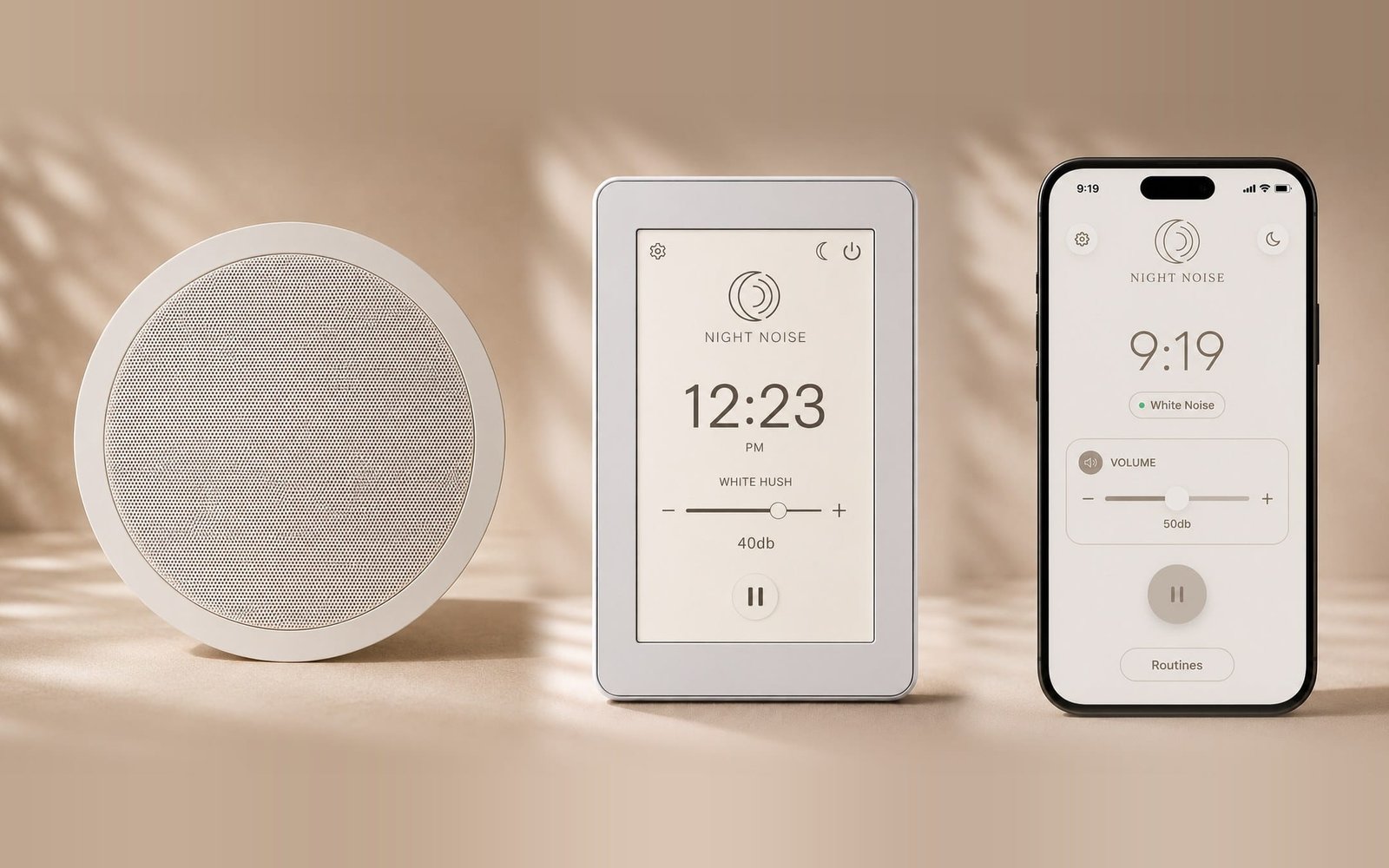
Night Noise, an Australian startup in the premium infant sleep market, set out to replace that with the world’s first Smart Sleep System. It combines professionally installed ceiling speakers, an in-wall touchscreen and a companion app, and the volume is calibrated for each room at installation.
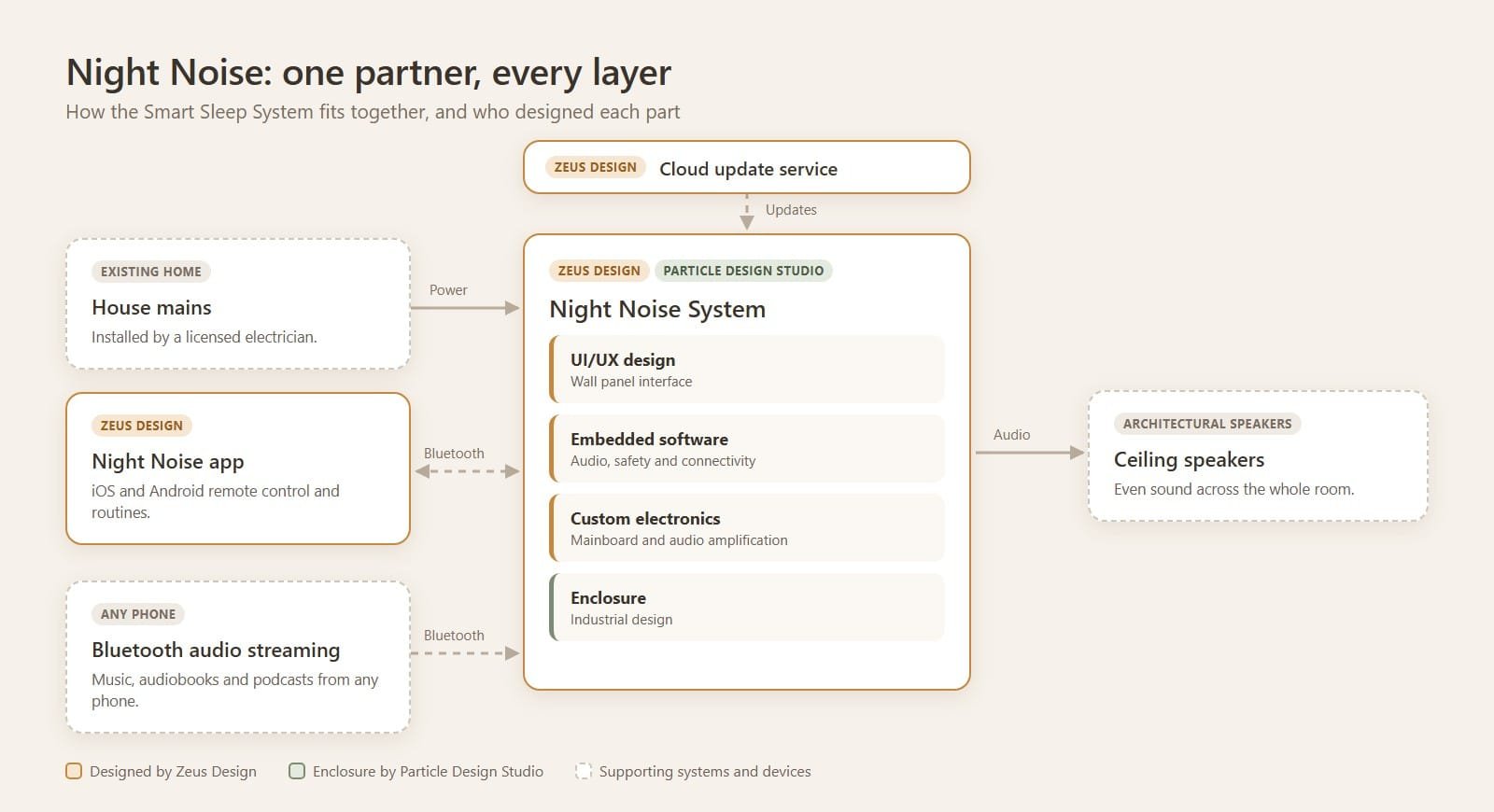
Night Noise engaged Zeus Design to take the product from concept to pilot production. We delivered what we call super full stack development: electronics hardware, embedded software, an iOS and Android app, cloud services and UI/UX design. Our industrial design partner, Particle Design Studio, designed the enclosure.
With prototypes developed and verified, the product is now in its pilot manufacturing run, with pilot installations signed up and ready to go.
Project at a Glance
- Client: Night Noise (nightnoise.com.au)
- Industry: Premium infant sleep, smart home audio
- Zeus Design scope: Requirements, electronics hardware, embedded software, iOS and Android app, cloud, UI/UX design, prototyping, design for manufacture
- Enclosure design: Particle Design Studio
- Status: In pilot manufacturing run, with pilot installations signed up
The Brief
Night Noise had a clear product vision and a demanding set of requirements:
- Safe: a volume limit set by a technician at installation and enforced by the system.
- Room-filling: even sound from multiple ceiling speakers, rather than a single point source.
- Reliable: all night, every night, without depending on a phone.
- Premium: a wall panel that suits a high-end interior.
- Future-ready: able to gain new features through software updates after installation.
As a startup, Night Noise also needed to keep development costs under control and reach a pilot-ready design without expensive surprises.
Our Approach: De-Risk First, Then Build
A Fixed-Price Discovery Phase
Rather than quoting full development up front on assumptions, we began with a small, fixed-price discovery phase covering:
- a touchscreen proof of concept, to confirm the display’s brightness, responsiveness and interface performance before committing to hardware
- a system requirements specification defining exactly what the product must do
- mockups of the wall panel and app screens
Once Night Noise signed off the requirements and designs, we provided a fixed-price statement of work for development. Night Noise knew what they were getting, and what it would cost, before committing to the larger spend.
Building on Proven Foundations
We built on proven hardware designs and software libraries from previous Zeus Design smart home projects. Starting from tested building blocks instead of a blank page reduced development time, cost and risk.
Deciding What Not to Build
Some of the most valuable early decisions were about what to leave out:
- Pre-certified power and radio modules reduce certification cost and time.
- No backup battery in the first release avoids added complexity, certification overhead and standby-safety requirements. It can be revisited once the core platform is certified.
- The display doubles as a night light, so no separate lighting hardware is needed.
- Night Noise chooses the speakers, which keeps them flexible on suppliers and aesthetics.
Super Full Stack: One Partner, Every Layer
Connected products are often split across several suppliers: one for the circuit board, another for the firmware, an agency for the app and someone else for the cloud. Each handover adds cost and risk, and problems tend to sit in the gaps between suppliers.
On Night Noise, Zeus Design delivered every layer:
- Requirements and system design
- Electronics hardware: a custom mainboard integrating compute, multi-channel audio amplification, power and protection
- Embedded software running the panel, audio, Bluetooth and safety features
- Mobile app for iOS and Android
- Cloud services for over-the-air updates
- UI/UX design for the wall panel and app
With one partner responsible for the whole system, each trade-off could be made where it best served the product rather than where a supplier boundary happened to fall.
The Engineering Challenges
From the outside, Night Noise looks simple. Making it look that simple took real engineering.
Power From a Small Space
The in-wall panel combines a touchscreen, a compute module with wireless connectivity, and enough amplification to drive multiple ceiling speakers. All of it runs at once, from a compact low-voltage supply, inside a slim wall-mounted enclosure. Every subsystem had a power budget, and efficient amplification was essential.
Thermals
All of that power ends up as heat, and the electronics sit in a wall cavity, in a slim enclosure, playing through the night. We treated thermal performance as a design input from day one. We planned component selection and board layout around heat, and worked closely with Particle Design Studio so that the electronics and enclosure manage heat together. Built-in thermal protection adds a safety backstop.
EMC
EMC (electromagnetic compatibility) means a product doesn’t emit excessive electrical interference or get disrupted by it, and it was just as critical here. Fast-switching amplifiers, Wi-Fi and Bluetooth radios, a compute module and long speaker cable runs all share close quarters. We addressed this at the design stage rather than in the test lab, which also keeps unwanted hiss and hum out of a quiet nursery. The system is designed to meet Australian safety, EMC and radiocommunications requirements, with other markets considered from the start.
Safety and Reliability Across Every Layer
Night Noise’s defining feature, its installer-calibrated volume limit, depends on the hardware, embedded software and app working as one. The limit set at installation holds whether sound is controlled from the wall panel, the app or a scheduled routine. We approached reliability the same way: continuous all-night playback, automatic recovery from faults, and schedules that run on the device itself without needing a phone.
UI/UX: Designed for the Real Moment of Use
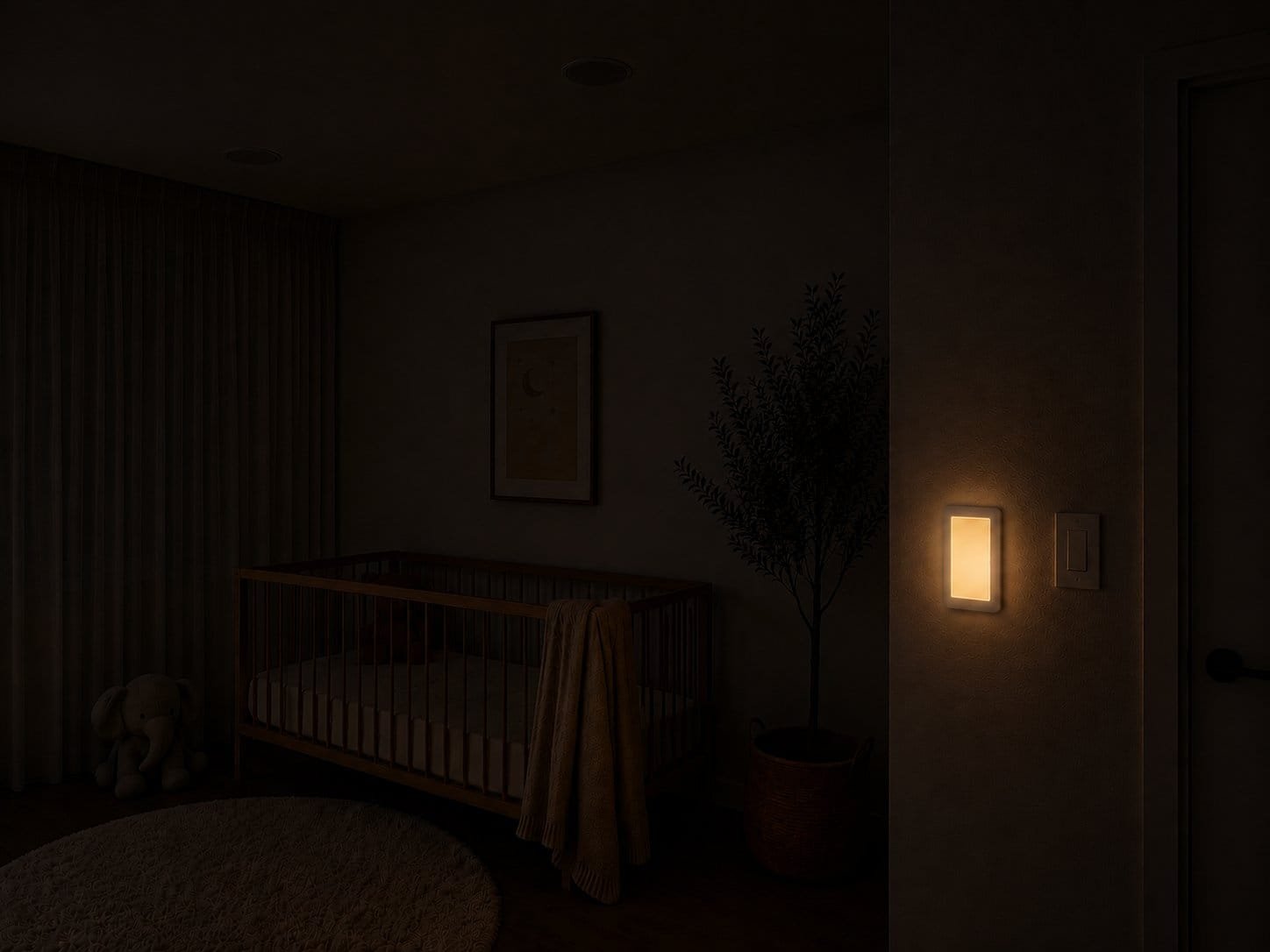
Night Noise is often used by a tired parent in a dark room, and that shaped every screen. The wall panel works instantly, with no phone or login. The display switches itself off and has a warm night light mode. The app mirrors the panel, adds scheduled routines and doesn’t require an account.
Industrial Design With Particle Design Studio
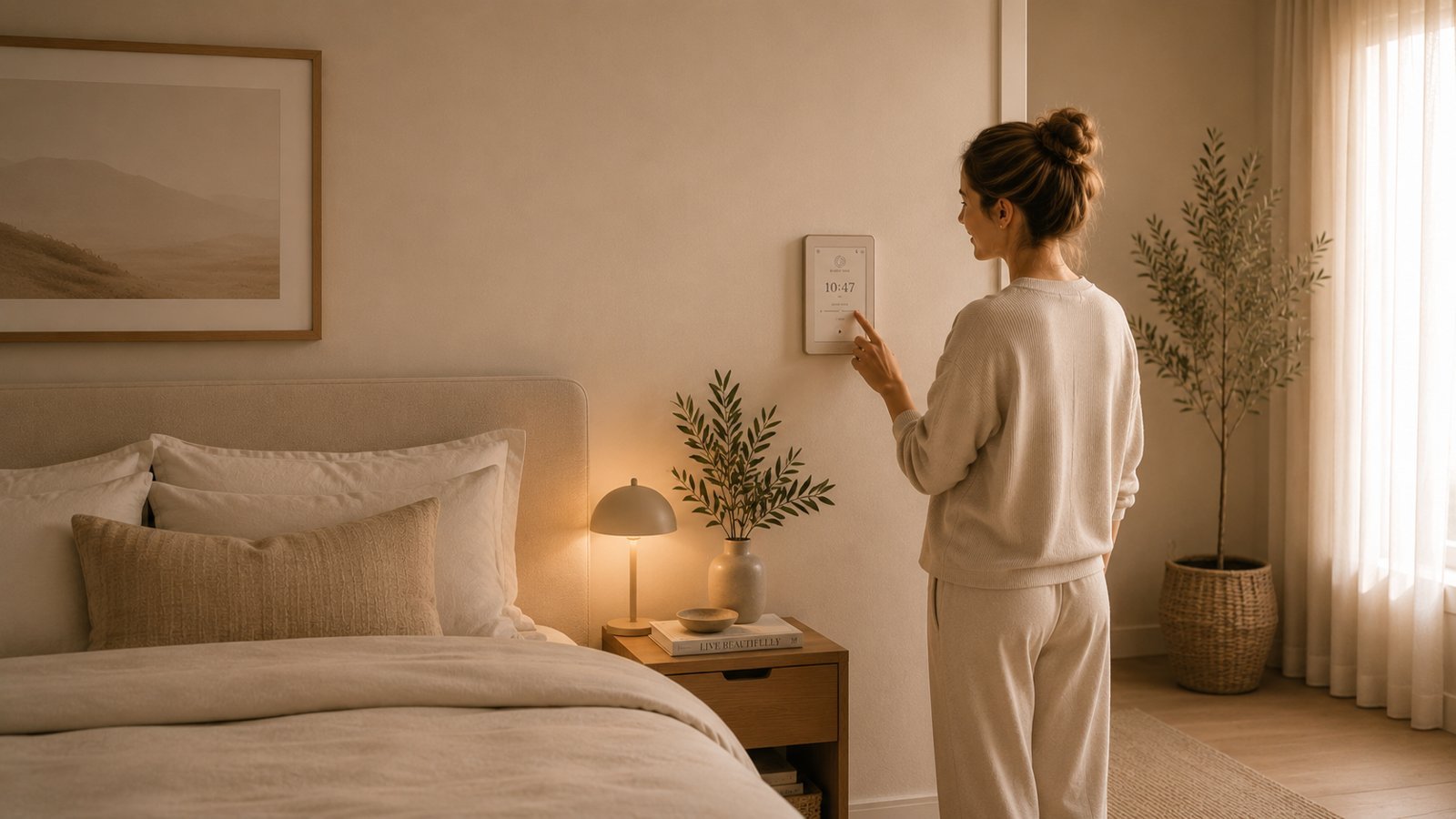
On our recommendation, Night Noise engaged our industrial design partner Particle Design Studio to design the enclosure, so that the wall panel sits cleanly in a premium interior.
Because thermal performance depended on the enclosure as much as the electronics, we worked closely with Particle on fit, display mounting and heat management. The electronics and enclosure were developed as one product, not handed over at the end.
From Prototype to Pilot Run
- Prototypes built and verified: We built functional prototypes and verified them against the system requirements, with units set aside for EMC testing.
- Designed for production: The mainboard includes provision for automated production testing, and we prepared production programming and assembly procedures.
- Pilot before scale: We advise every hardware client to complete a pilot run, typically 100 to 200 units, before volume manufacturing. A pilot run validates the manufacturing process, real-world installation and compliance with the specification while the stakes are still small.
Night Noise is now in its pilot run, with pilot installations signed up and ready to go.
Results
- A complete product system from one partner: hardware, embedded software, iOS and Android app, cloud and UI/UX.
- Costs defined before major spend, through a fixed-price discovery phase.
- Thermal and EMC performance designed in from the start.
- From concept to pilot run, with production testing and procedures in place and pilot installations signed up.
Lessons for Startup Founders
- Pay for clarity before you pay for development. A short discovery phase turns assumptions into a specification and a fixed price.
- Decide early what not to build. Pre-certified modules and a focused first release save time, money and certification effort.
- Treat thermals and EMC as design inputs, not test results. Finding these problems in a test lab is the expensive way.
- One partner across the stack removes the gaps that appear between separate suppliers.
- Pilot before you scale. A small run exposes manufacturing and installation issues while they’re still cheap to fix.
Looking Ahead
Night Noise is creating a new category of product: a permanent, professionally installed sleep environment that grows with the family. The platform has the headroom to gain new features through software updates, with no change to the hardware.
Zeus Design is proud to be Night Noise’s engineering partner, and we look forward to supporting them through pilot installations and into full production.
About Night Noise
Night Noise is an Australian company behind the world’s first Smart Sleep System: professionally installed, individually calibrated sound for better sleep, from the nursery to adulthood. Learn more at nightnoise.com.au.





0 Comments